Excursions Daguerriennes. Vues et Monuments les plus remarquables du Globe.
Author: Lerebours a.o.
Year: 1842
Edition: First edition
Publisher: Lerebours
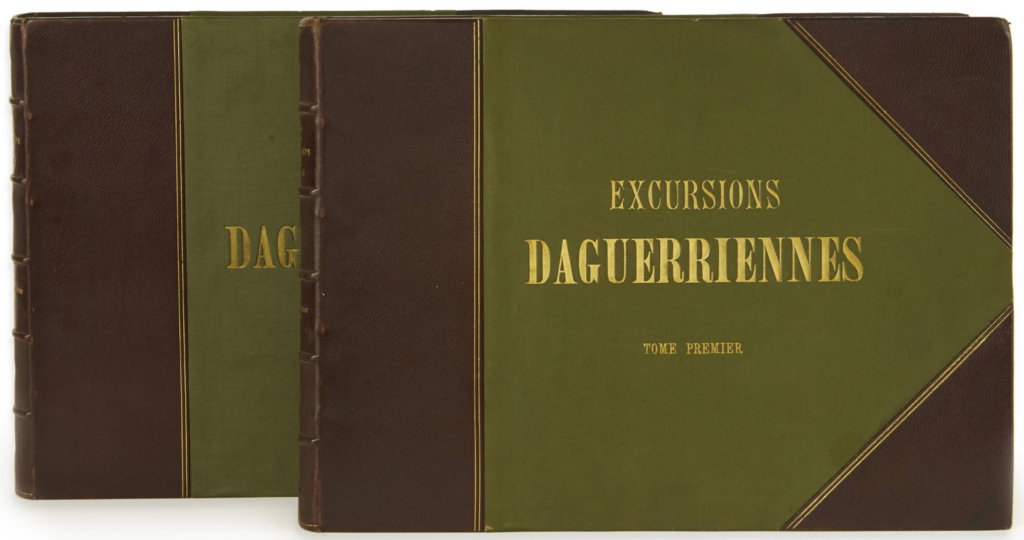
Two volumes, oblong 4to, paper size: 255 × 338 mm, contemporary half wine-lees shagreen, the edges of the leather on both green cloth boards decorated with double gilt filets, front boards with the title in gilt, the spines divided in six compartments by five raised bands with the titles in the second and fourth compartments, all edges gilt. Vol. I with half title and title page, vol. II with half title only as usual.
Volume I complete with all 60 plates usually found in this volume and volume II with 50 plates. Both volumes complete as per the plate indexes.
The plates printed on India paper and generally very clean with occasionally some very light foxing. All plates protected with tissue guards.
The importance of this book lies in its plates. In 1839 the Daguerreotype was introduced and for the first time in history images could be recorded from reality directly on a metallic plate. This process was far more accurate of course than the drawings made on the spot, the only possible method till then. Lerebours, an optician from Paris, had a keen interest in the daguerreotype process. He was one of the first to understand the immense importance of this process for publishing purposes and took on to publish a book with the worlds known most important monuments and landscapes at the time, like the ancient temples of Greece and buildings and city views in the Middle East, as well as impressive sights like the Niagara Falls. They all can be found in these tomes.
There was no solution yet (1841-1842) to reproduce the photographs directly to paper, so that Lerebours had these pictures engraved to have them printed.
One of the problems with early photography was the long exposure time required; living objects like people, animals and birds could not be captured. Lerebours solved this by having added figures to the engravings to make them livelier. Although this sometimes nowadays leads to discussions about the accuracy of the plates by some critics, it is generally accepted that these plates were the most accurate to date in the early 1840’s. Details ignored or omitted by many draftsman till then suddenly, sometimes painfully, became visible. As such this is an extremely important book in the history of publishing.
Originally he intended to publish 50 plates, but expanded the number to 60. These 60 plates at first were published in two volumes with 30 plates each {¹}. Later, when the total number of daguerreotypes was increased to over 100 plates, these first 60 plates were combined in one volume, published as vol. I. {²}
There are several different indexes for vol. I with regard to the sequence of the plates, however, there are no differences with regard to which plates are bound in this volume; it always concerns the same 60 plates.
Each plate is preceded by 2 – 5 pages of letterpress, written by various experts on the subject shown in the respective plate.
Below the list of the 60 plates found in vol. I, with above the letterpress title, followed by the author of the accompanying text with in brackets the number of text pages accompanying that plate, next the captions of the plates with in braces the name of the engraver and finally the title as per the plate index.
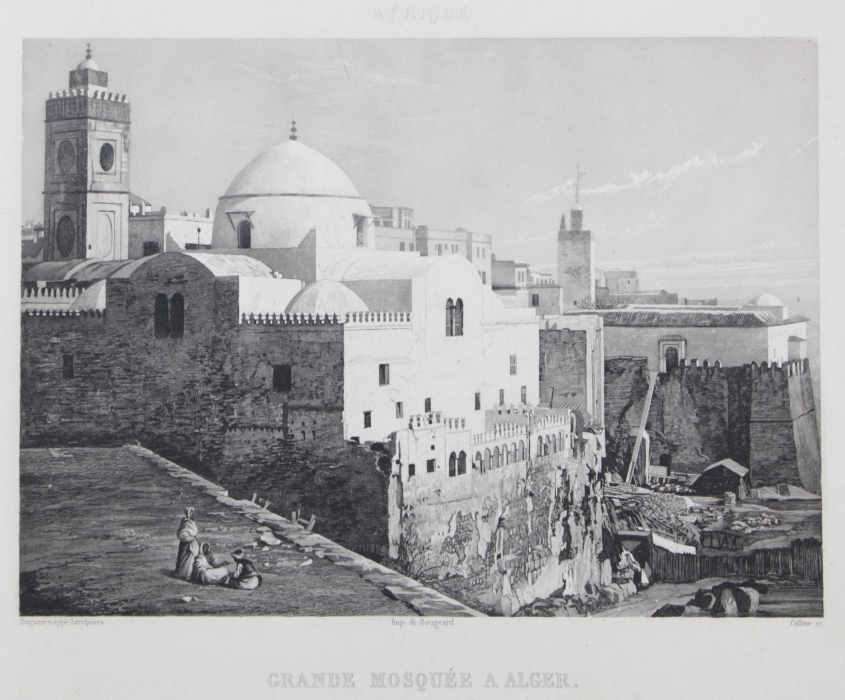
1) Alger
Eugene de Lasiauve (2)
Grande Mosquée à Alger {Callow}
Alger
2) Bréme
Eugene de Lasiauve (2)
Hôtel de ville de Bréme {Hürlimann}
Hôtel-de-ville
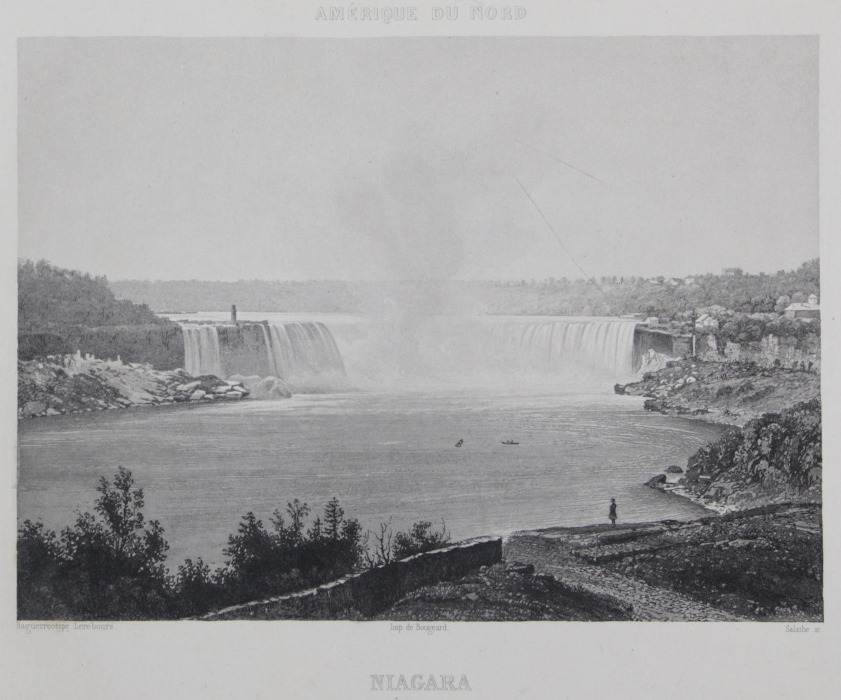
3) Cataracte du Niagara
M.H.L. Pattinson (2) **
Niagara {Salathé}
Chute de Fer-à-cheval (Niagara)
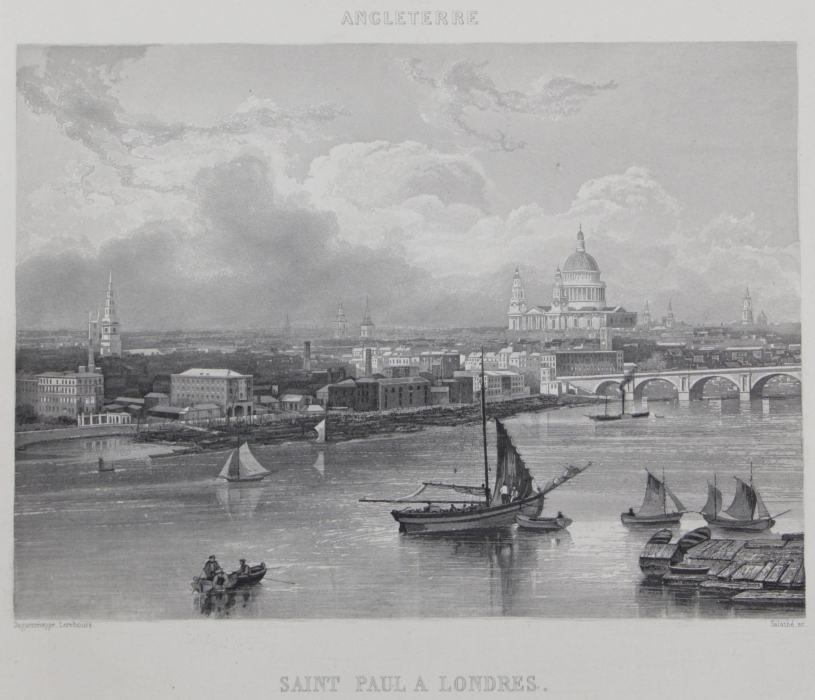
4) Londres
Paul de la Garenne (2)
Saint Paul à Londres {Salathé}
Saint Paul à Londres
5) [i=6] Harem de Mehémet-Ali
Fr. Goupil-Fesquet (2)
Harem de Méhémet-Ali à Alexandrie {Weber}
Harem de Méhémet-Ali à Alexandrie
6) [i=5] La Colonne de Pompée
F. Coupil (2)
Colonne de Pompée {Martens}
Colonne de Pompée à Alexandrie
7) Louqsor
Fr. Goupil-Fesquet (2)
Louqsor {Martens}
Louqsor
8) Pyramide de Cheops
Fr. Goupil-Fesquet (4)
Pyramide de Cheops {Riffaut}
Pyramide de Chéops
9) La vallée des Tombeaux
Gustave Deville (2)
La vallée des Tombeaux {Salathé}
La vallée des Tombeaux
10) Alcazar de Séville
Ed. Jomard (2)
Alcazar de Séville {Riffaut}
Alcazar de Séville
11) L’Alhambra
Edmond Jomard (2)
Alhambra {Salathé}
Alhambra
12) Grenade
Edmond Jomard (2)
Grenade {Salathé}
Grenade
13) Les Arènes
De Contencin (3 + 1 blank)
Les Arènes à Nimes {Himely}
Les Arènes à Nimes
14) La Maison Carée (2)
Maison Carrée à Nimes {Callow}
La Maison-Carrée à Nimes
De Contencin
15) La Tour Magne
Paul de la Garenne (2)
La Tour Magne à Nimes {N.P. Lerebours}
La Tour-Magne à Nimes
16) Arc-de-Triomphe d’Orange
Paul de la Garenne (2)
Arc-de-Triomphe d’Orange {Hürlimann}
Arc-de-Triomphe d’Orange
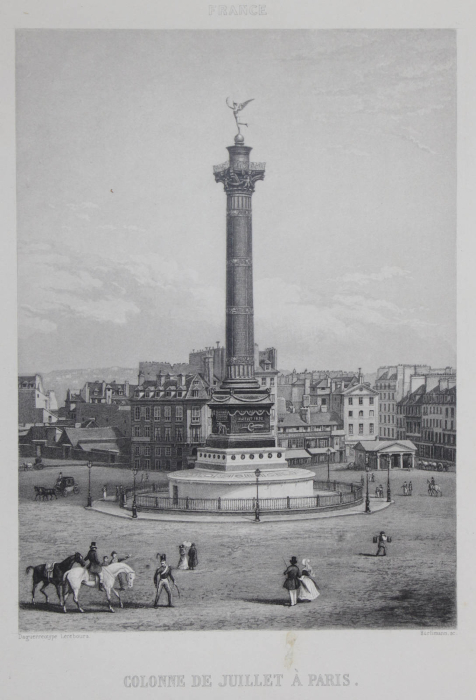
17) La Colonne de Juillet
Boquillon (2)
Colonne de Juillet à Paris {Hürlimann}
La Colonne de Juillet à Paris
18) Saint-Germain l’Auxerrois
Fr. Goupil-Fesquet (3 + 1 blank)
St. Germain l’Auxerrois à Paris {Hürlimann}
Saint-Germain-l’Auxerrois à Paris
19) Notre Dame de Paris
Fr. Goupil-Fesquet (2)
Porte Laterale de Notre Dame à Paris {Himely}
Porte Laterale de Notre-Dame à Paris
20) Le Pont-Neuf
Gustave Deville (2)
Vue prise du Pont Neuf à Paris {Martens}
Vue prise du Pont-Neuf à Paris
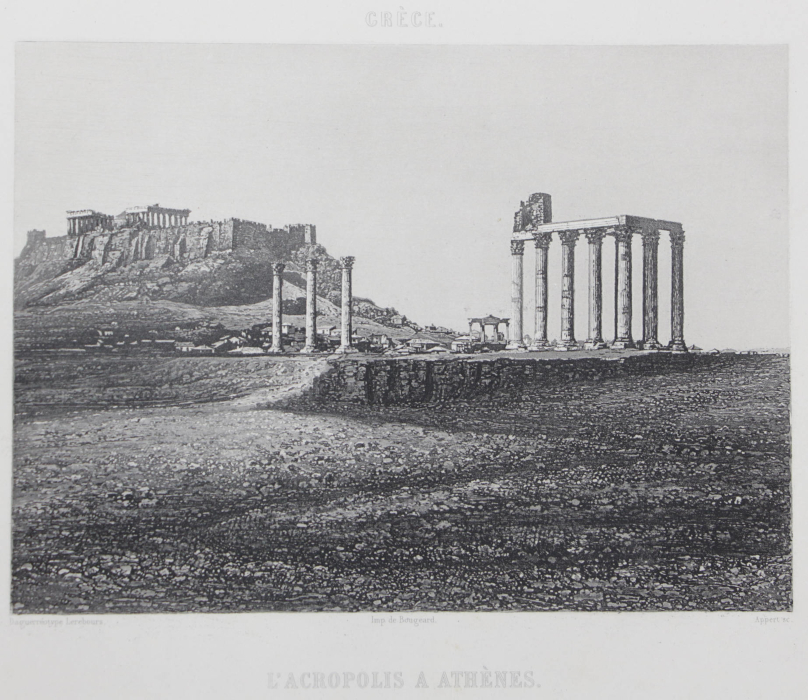
21) Athènes
Paul de la Garenne (2)
L’Acropolis à Athène {Appert}
L’Acropolis à Athène
22) Le Parthénon ou Temple de Minerve
Joly de Lotbinière (2)
Le Parthénon à Athène {Martens}
Le Parthénon à Athène
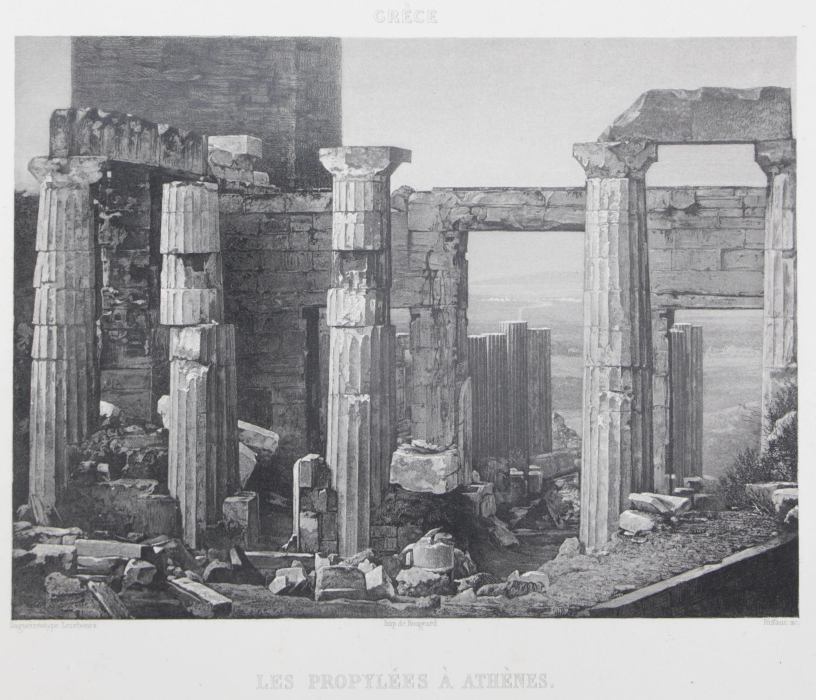
23) Vue des Propylées
Joly de Lotbinière (2)
Les Propylées à Athène {Riffaut}
Les Propylées à Athène
24) Longwood
Alphonse Chedeville (2)
Maison de Longwood [St. Hélène] {Thiénon}
Maison de Longwood
25) La Place du Grand Duc
Jules Janin (2)
Place du Grand Duc à Florence {Salathé}
La Place du Grand-Duc à Florence
26) Le Fort Neuf
Paul de la Garenne (2)
Fort Neuf à Naples {Paul Legrand}
Le Fort-Neuf à Naples
27) Naples
Paul de la Garenne (2)
Le Môle à Naples {Salathé}
Le Môle à Naples
28) Temple de Cérès à Pestum
Paul de la Garenne (2)
Temple de Cérès à Pestum {Martens}
Temple de Cérès à Pestum
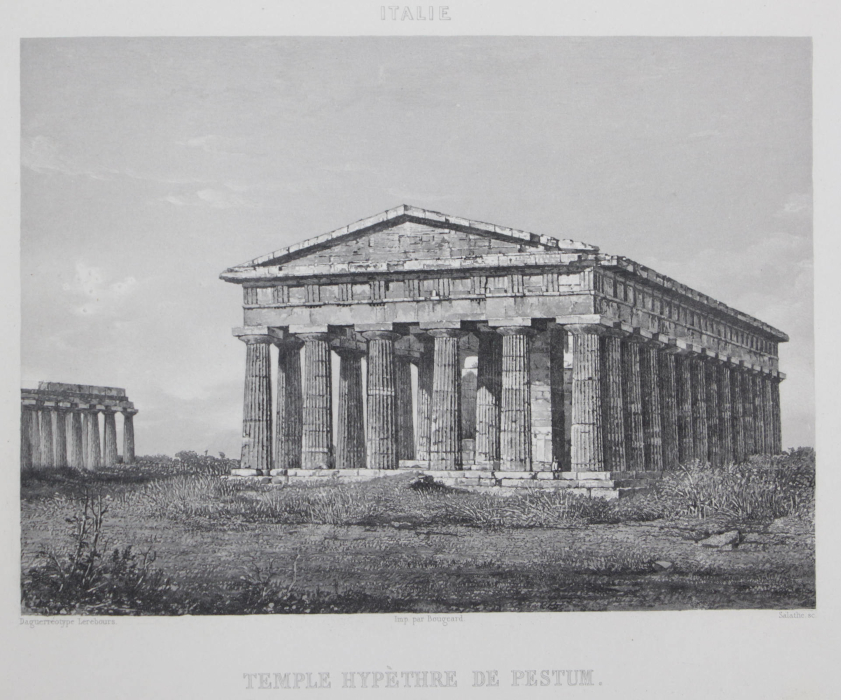
29) Temple Hypèthre de Pestum
Paul de la Garenne (2)
Temple Hypèthre de Pestum {Salathé}
Temple Hypèthre de Pestum
30) Le Duomo et la Tour Penchée
Paul de la Garenne (2)
Le Duomo et la Tour Penchée à Pise {Callow}
Le Duomo et la Tour-Penchée à Pise
31) Santa Maria della Spina
Paul de la Garenne (2)
Santa Maria della Spina à Pise {Salathé}
Santa Maria della Spina à Pise
32) Arc de Constantin
Paul de la Garenne (2)
Arc de Constantin à Rome {Himely}
Arc de Constantin à Rome
33) L’Arc de Titus
Paul de la Garenne (2)
L’Arc de Titus à Rome {Callow}
Arc de Titus à Rome
34) Les Cascades de Tivoli
C.S. Azario (2)
Les Cascades de Tivoli {Salathé}
Cascades de Tivoli à Rome
35) Vue du Colysée
Paul de la Garenne (2)
Le Colisée à Rome {Himely}
Le Colisée à Rome
36) La Colonne Trajane
Paul de la Garenne (2)
Colonne Trajane à Rome {Hürlimann}
La Colonne Trajane à Rome
37) Église de Sainte-Marie-Majeure
Paul de la Garenne (2)
Ste. Marie Majeure à Rome {Price}
Sainte-Marie-Majeure à Rome
38) Saint Pierre et le Fort Saint-Ange
Paul de la Garenne (2)
Saint Pierre et le Fort Saint-Ange à Rome {Weber}
Saint-Pierre et le Fort Saint-Ange à Rome
39) La Place du Peuple
Jules Janin (2)
Place du Peuple à Rome {Martens}
La Place du Peuple à Rome
40) Vue de la Ripetta
Paul de la Garenne (2)
Port Ripetta à Rome {Himely}
Le Port Ripetta à Rome
41) Vue du Temple de Vesta
Paul de la Garenne (2)
Temple de Vesta à Rome {Martens}
Temple de Vesta à Rome
42) Monte-Mario
Paul de la Garenne (2)
Monte-Mario {Salathé}
Monte-Mario près de Rome
43) L’Arsenal
Paul de la Garenne (2)
L’Arsenal à Venise {Martens}
L’Arsenal à Venise
44) Église Saint-Marc
Paul de la Garenne (3 + 1 blank)
Église St. Marc à Venise{Hürlimann}
Église St. Marc à Venise
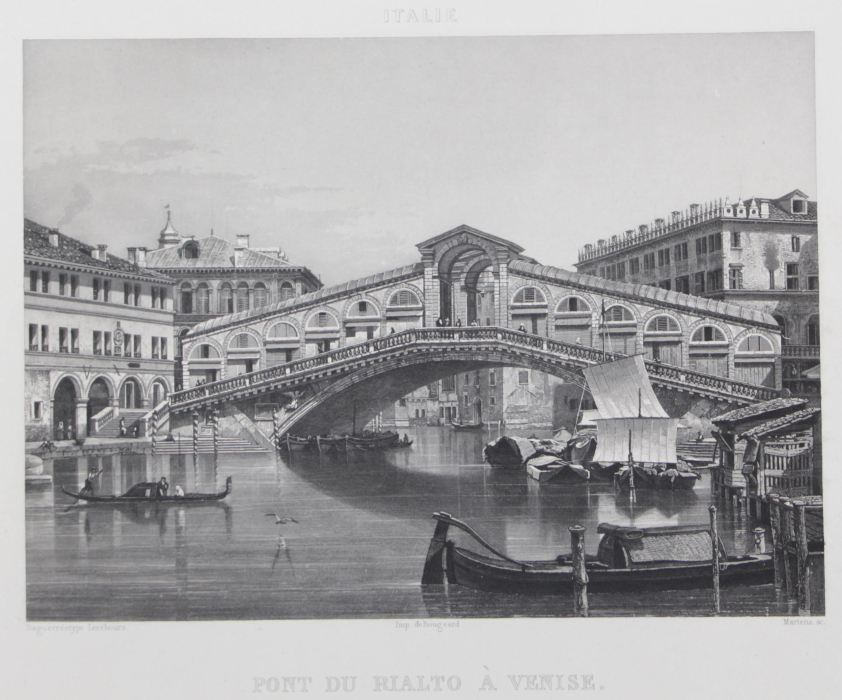
45) Pont du Rialto
Paul de la Garenne (2)
Pont du Rialto à Venise {Martens}
Pont de Rialto à Venise
46) Vue prise de la Piazetta
Paul de la Garenne (2)
Vue prise de la Piazetta à Venise {Martens}
Vue prise de la Piazetta à Venise
47) Vue prise de l’Entrée du Grand Canal à Venise
Paul de la Garenne (2)
Vue prise de l’Entrée du Grand Canal à Venise {Martens}
Vue prise de l’Entrée du Grand Canal à Venise
48) Vue prise du Clocher de Saint-Marc
Paul de la Garenne (2)
Vue prise du Clocher de St. Marc à Venise {Salathé}
Vue prise du Clocher de Saint-Marc à Venise
49) Temple Hypèthre dans l’Ile de Philæ
Joly de Lotbinière (3 + 1 blank)
Temple Hypèthre. Dans l’Ile de Philæ {Bishop & Weber}
Temple Hypèthre dans l’Ile de Philæ
50) Jerusalem
F. Goupil (2)
Jerusalem {Salathé}
Jerusalem
51) Moscou
Paul de la Garenne (2)
Moscou {Legrand}
Moscou
52) Église de Vassili Blagennoï
Paul de la Garenne (2)
Vassili Blagennoï à Moscou {Legrand}
Vassili Blagennoï à Moscou
53) Le Kremlin
Paul de la Garenne (2)
Vue du Kremlin à Moscou {Hürlimann}
Vue du Kremlin à Moscou
54) Stockholm
Eugene de Lassiauve (2)
Église de la Marine à Stockholm {Hürlimann}
Église de la Marine à Stockholm
55) Genève
Louis Spach (4)
Genève {Bishop & Weber}
Genève
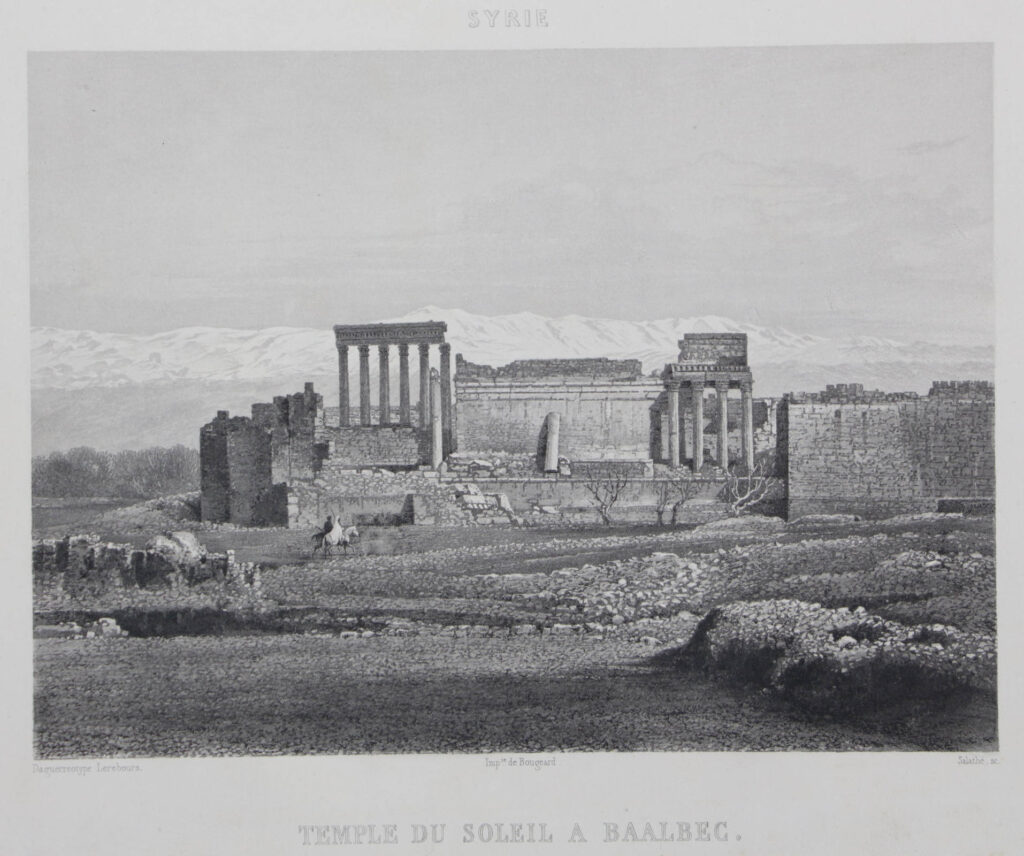
56) Ruines du Temple du Soleil à Baalbec
Joly de Lotbinière (2)
Temple du Soleil à Baalbec {Salathé}
Temple du Soleil à Baalbec
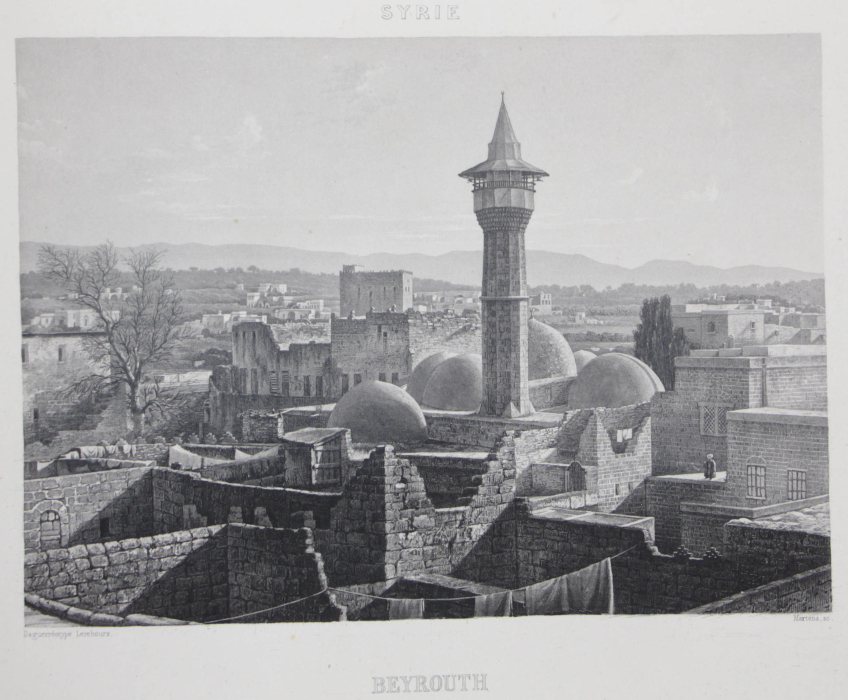
57) Beyrouth
F. Goupil (2)
Beyrouth {Martens}
Beyrouth
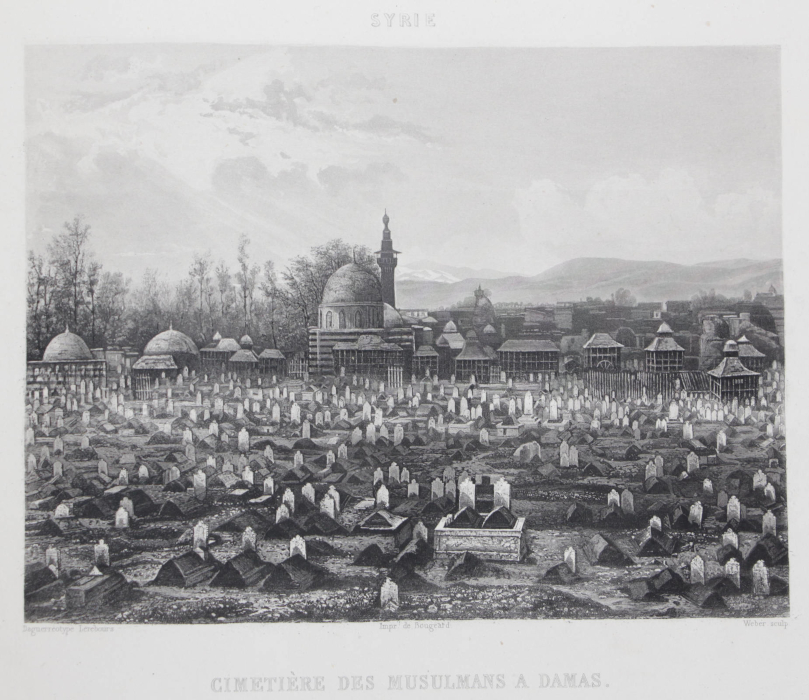
58) Cimetière des Musulmans à Damas
Joly de Lotbinière (2)
Cimetière des Musulmans à Damas {Weber}
Cimetière des Musulmans à Damas
59) Saint-Jean-d’Acre
F. Goupil (2)
St. Jean d’Acre {Salathé}
Saint-Jean-d’Acre
60) Nazareth
F. Goupil-Fesquet (2)
Nazareth {Salathé}
Nazareth
Please note that nrs. 5 and 6 above are bound in the wrong sequence compared to the plate index.
So number 5 is number 6 in the index “[i=6]” and plate number 6 is number 5 in the index “[i=5]”. All the other numbers match the index numbers.
** According to a publisher’s note the text accompanying Niagara Falls was written by M.H.L. Pattinson from Newcastle upon Tyne and translated by M.A. Claudet.
Below the list of the 50 plates found in vol. II, with above the letterpress title, followed by the author of the accompanying text with in brackets the number of text pages accompanying that plate, next the captions of the plates with in braces the name of the engraver and finally the title as per the plate index.
1) Vue d’ Avignon
Jules Gourmez (2)
Avignon {Salathé}
Vue générale d’ Avignon
2) La Porte taillée
L. Batissier (2)
Porte Creusée dans le roc {Riffaut}
Porte taillée dans le roc à Besançon
3) Porte-noire de Besançon
Ch. Nodier (2)
Porte-noire à Besançon {Hürlimann}
Porte-noire à Besançon
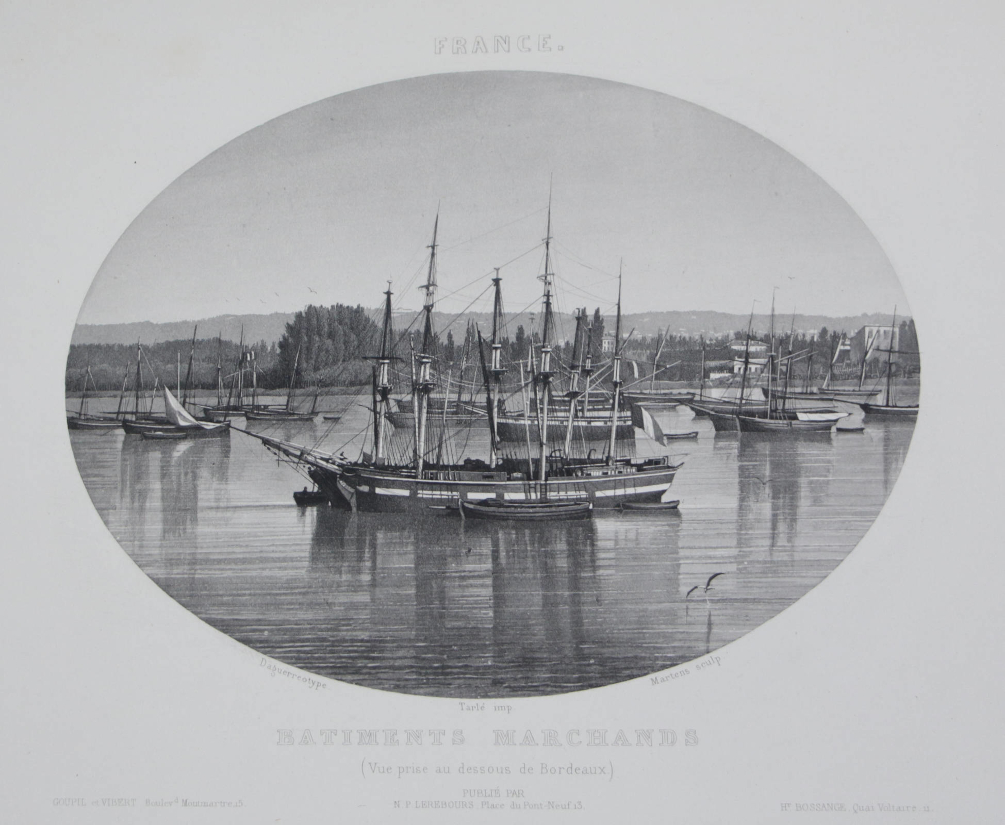
4) Vue prise au-dessoux de Bordeaux
Paul de la Garenne (2)
Batiments Marchands {Martens} {3}
Bàtiment en rade à Bordeaux
5) Église Sainte-Croix
De Contencin (3 + 1 blank)
Église de Ste. Croix à Bordeaux {Himely}
Église de Sainte Croix à Bordeaux
6) Le Palais Galien
L. Batissier (2)
Le Palais Galien à Bordeaux {Salathé}
Palais Galien à Bordeaux
7) Le Port des Quinconces
De Contencin (2)
Port des Quinconces à Bordeaux {Salathé}
Port des Quinconces à Bordeaux
8) La Cathédrale de Chartres
N.P. lerebours (2)
Portail de la Cathédrale de Chartres {Himely}
Portail de la Cathédrale de Chartres
9) Fontainebleau
Paul de la Garenne (2)
Chateau de Fontainebleau {Appert}
Château de Fontainebleau
10) Le Pont du Gard
Paul de la Garenne (2)
Le Pont du Gard {Salathé}
Pont du Gard
11) Grenoble
Paul de la Garenne (2)
Vue de Grenoble {Bichebois}
Vue générale de Grenoble
12) Le Chateau Gaillard
F. Fayot (2)
Chateau Gaillard {Deroy}
Vue du Château Gaillard
13) Chateau de Lesdiguières à Vizille
Victor Terte (2)
Chateau de Lesdiguières près Grenoble {Vaugel}
Vue du Château de Lesdiguières
14) Église Métropolitaine de Saint-Jean
De Contencin (3 + 1 blank)
St. Jean à Lyon {Salathé}
Église Saint-Jean à Lyon
15) L’Hotel de Ville de Lyon
Léon Boitel (3 + 1 blank)
Hotel de Ville de Lyon {Salathé}
Hotel-de-Ville à Lyon
16) Lyon
Léon Boitel (2)
Vue prise de Quai St. Antoine à Lyon{Salathé}
Les quais de la Saône à Lyon
17) A propos d’une Vue prise à Bas-Meudon
Challamel (2)
Vue prise à Bas-Meudon {Daubigny}
Vue prise au Bas-Meudon
18) Vue prise en Normandie
Challamel (2)
Vue de Normandie {Salathé}
Vue prise en Normandie
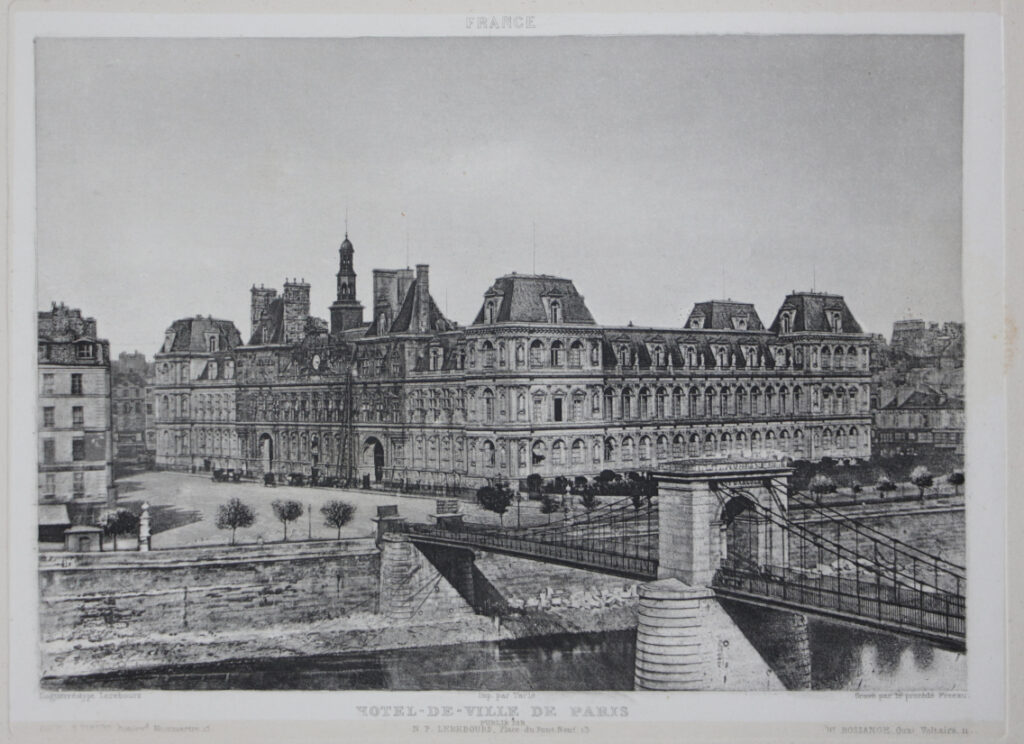
19) L’Hotel-de-Ville de Paris
R. Lorembert (2)
Hotel-de-Ville de Paris {Gravé par le procédé Fizeau} {4}
Hotel-de-Ville de Paris
20) Façade Méridionale de l’Église des Invalides
Paul de la Garenne (2)
Église des Invalides {Fichot}
Église des Invalides à Paris
21) Notre-Dame
Anonymous (2)
Façade de Notre-Dame de Paris {Petit}
Notre-Dame de Paris (façade)
22) Notre-Dame de Paris
De Contencin (2)
Portail de Notre-Dame de Paris {Hürlimann} {5}
Notre-Dame de Paris (portail)
23) Notre-Dame de Paris
De Contencin (2)
Notre-Dame de Paris {Mignan}
Notre-Dame de Paris (prise du côté de l’abside)
24) Arc de Triomphe de l’Étoile
Jules Janin (4)
Arc de Triomphe de l’Étoile à Paris {Hürlimann}
Arc de triomphe de l’Étoile à Paris
25) Le Chateau de Gaillon
L. Batissier (2)
Façade du Chateau de Gaillon à Paris {Hürlimann}
Château de Gaillon, à Paris
26) Le Jardin des Tuileries
Paul de la Garenne (2)
Jardin des Tuileries à Paris {Webert}
Jardin des Tuileries à Paris
27) Vue du Pavillon de Flore
Paul de la Garenne (2)
Vue du Pavillon de Flore {Himely}
Le Pavillon de Flore à Paris
28) Église de la Madeleine
Paul de la Garenne (2)
La Madeleine à Paris {Appert}
La Madeleine à Paris
29) Le Panthéon
Jules Janin (4)
Panthéon à Paris {Martens}
Le Panthéon à Paris
30) Place de la Concorde
Paul de la Garenne (2)
Place de la Concorde à Paris {Appert}
Place de la Concorde à Paris
31) Porte de la Bibliothèque du Roi
Lassus (2)
Porte de la Bibliothèque du Roi {Himely}
Porte de la Bibliothèque à Paris
32) Les Quais de Paris
L. Batissier (3 + 1 blank)
Vue prise du Pont Royal à Paris {Martens}
Vue prise du Pont Royal à Paris
33) La Métropole de Reims
De Contencin (2)
Métropole de Reims {Webert}
Métropole de Reims
34) Portail de Notre-Dame de Reims
Contencin (5 + 1 blank)
Portail de Notre-Dame de Reims {Hürlimann} {5}
Portail de Reims
35) Saint-Jean-des-Vignes
Dormoy (2)
St. Jean des Vignes à Soissons {Vogel}
Saint-Jean-des-Vignes à Soissons
36) La Cathédrale de Strasbourg
L. Batissier (2)
Cathédrale de Strasbourg {Cuvillier}
Cathédrale de Strasbourg
37) Chateau de Versailles
Paul de la Garenne (2)
Chateau de Versailles {Fichot}
Château de Versailles
38) Saint-Maurice de Vienne
Louis Batissier (2)
St. Maurice à Vienne {Vogel}
Église Saint-Maurin à Vienne
39) Tombeau de Pilate
L. Batissier (2)
Tombeau de Pilate {Himely}
Tombeau de Pilate près Vienne
40) La Cathédrale de Milan
Paul de la Garenne (2)
Cathédrale de Milan {Deroy}
Cathédrale de Milan
41) Vue prise de la Meta Sudante
Paul de la Garenne (2)
La Meta Sudante à Rome {Salathé}
La Meta Sudente à Rome
42) Vue prise du Campo Vaccino
Paul de la Garenne (2)
Vue prise du Campo Vaccino {Appert}
Vue prise du Campo Vaccino à Rome
43) Le Palais Ça-Doro
Paul de la Garenne (2)
Palais Ça-Doro à Venise {Arnout}
Palais Ça-Doro à Venise
44) Chateau Petrofski
Paul de la Garenne (2)
Chateau Petrofski {Hürlimann}
Château Petrofski à Moscou
45) La Vallée de Saint-Gervais et le Bonnant
T. Bettinger (2)
Vallée de Saint-Gervais et le Bonnant {Cicéri}
Vallée de Saint-Gervais et le Bonnant
46) Vallée et Village de Saint-Gervais
F. Bettinger (2)
Village de Saint-Gervais {Salathé}
Village de Saint-Gervais
47) Chateau delle Torri
Paul de la Garenne (2)
Chateau delle Torri à Turin {Vogel}
Château delle Torri à Turin
48) Le Mont-Blanc
T. Bettinger (2)
Vue du Mont-Blanc {Salathé}
Le Mont-Blanc
49) Fribourg
T. Bettinger (2)
Vue de Fribourg {Arnout}
Vue générale de Fribourg
50) Le Salève
T. Bettinger (2)
Le Salève {Vogel}
Le Salève
All numbers given above match the index numbers.
Important note about the names of the authors of the accompanying texts:
These names have been copied exactly from the text pages. So “F. Goupil-Fesquet” sometimes also will be found as “Fr. Goupil-Fesquet” or just “F. Goupil” Also sometimes names are spelled differently, like “Lasiauve” and “Lassiauve”, or just an initial differs like in “F. Bettinger” and “T. Bettinger”.
The single most important contributor for the accompanying texts is Paul de la Garenne with 44 entries.
The entire project apparently was planned to comprise 114 plates {6} although we we have been unable to trace a copy in institutional libraries, auction records or dealer catalogues with more than the 113 plates described in this article.
The three plates not included in our volume II are:
Pont de Nemours (2) {Arnout}
Maison élevée à Paris (2) {Gravé par le procédé Fizeau}
Bas-Relief de Notre-Dame (2) {Gravé par le procédé Fizeau}
Except these three plates these two volumes contain all plates ever issued, taking it for granted that plate nr. 114 simply does not exist.
Some of the most wellknown daguerreotypists contributed to this work, like e.g. Gaspard-Pierre-Gustave Joly de Lotbinière who took the first photographs ever of the Acropolis and the Parthenon. Frédéric Goupil-Fesquet amongst others took pictures of the Great Pyramid of Giza, Luxor, Jerusalem, Nazareth and some other places in the Middle East, while Hugh Lee Pattinson photographed the Niagara Falls. Many others, often unknown now, contributed to this work as well.
The engravings were done by the most eminent engravers of the time. Especially Salathé with his expertise of grey shades in aquatint was of importance, but also the contributions of other engravers like Adolphe-Pierre Riffaut known for his highly detailed architectural plates, including famous early views of Athens and the Alhambra, Sigismond Himely and Frédéric von Martens greatly attributed to the exceptionally high quality of these plates.,
Our copy contains one of the three Fizeau plates;, viz. the plate titled: L’Hotel-de-Ville de Paris.
Hippolyte Fizeau successfully adapted the traditional etching process to the daguerreotype plate, making it possible to reproduce images directly from the plate onto paper.
So what might be considered the first three photographs ever to be printed directly from the plates and to be reproduced in a book, were those published in the Excursions Daguerriennes.
Here below the beginning of an article written by Michèle Hannoosh, then professor of French at the University of Michigan, as posted on the website of the British Library August 5th, 2015:
On 19 August 1839, the astronomer François Arago demonstrated to the French Academy the startling new photographic process invented by Louis Daguerre, by which an object was imprinted on a metal plate without human intervention, through the action of light alone. Within just a few weeks, budding daguerreotypists had learned the technique and set off to try their luck in far-flung destinations across Europe, Africa and the Near East.
This was no easy task: the travellers had to transport nearly 300 pounds of equipment, dangerous chemicals and inconvenient supplies; with no precedents to guide them in climates very different from that of Paris they had to experiment with lighting, aspect, exposure times, chemical combinations and conditions for developing the pictures; they often had nothing to show for their efforts but a blank plate. Where they succeeded, however, they produced the first photographic images ever made of these regions, having enormous historical and aesthetic importance, and inaugurated a practice which would forever alter the experience of travel.
But for the foresight of an enterprising Parisian optician and maker of scientific instruments named Noël-Paymal Lerebours, there would be little evidence of this pioneering photographic activity: the daguerreotype process does not allow the plate to be reproduced and few originals survive. Lerebours gathered together over a hundred of these daguerreotypes, had them traced and then engraved: the resulting Excursions daguerriennes: Vues et monuments les plus remarquables du globe (Paris, 1841-42; British Library 1899.ccc.18) was the first book to be illustrated from photographs. The images represented sites throughout Europe, from Russia and Sweden to Spain and Greece; around the Mediterranean from Algiers to Beirut; and further afield to the Americas.
Each image was accompanied by a text signed, in most cases, by a professional critic or man of letters. The photographers, on the other hand, are not indicated and most are therefore unknown.
There are two notable exceptions. Gustave Joly de Lotbinière, a Swiss-born Canadian seigneur who was in Paris en route to the Near East when Daguerre’s invention was announced, and Frédéric Goupil-Fesquet, a student of the French painter Horace Vernet whom he was preparing to accompany to Egypt and the Levant, both grasped the potential of the new process and quickly availed themselves of it. Joly left for Greece on 21 September 1839 and became the first person ever to photograph Athens; over the following eight months he took daguerreotypes of Egypt, Syria, Lebanon, Palestine, Cyprus, Rhodes, Istanbul, and Malta. Goupil-Fesquet left for Egypt with Vernet in October, taking a slightly different route through the Levant and back to France by way of Izmir and Rome. Both photographers kept journals of their travels and drew upon them for the texts that they wrote to accompany their images in Excursions daguerriennes. Joly contributed the chapters on the Parthenon, the Propylaeia, the temple at Philae, the Temple of the Sun at Baalbek and the Muslim cemetery at Damascus. Goupil-Fesquet produced those on Pompey’s Pillar, the harem of Mehmet Ali in Alexandria, Luxor, the Great Pyramid, Jerusalem, Beirut, Acre and Nazareth.
The importance of this publication hardly can be overestimated.
Although the publication of 114 plates was announced, no copies containing more than 113 plates are known, but collation remains very difficult. For instance the index of Vol. II in the copy of the BnF lists 51 plates, but 52 are present. The Fizeau plate “Maison élevée à Paris”, not listed in the index, is bound in this volume in between the plates “Vue prise du Pont-Royal à Paris” and “Métropole de Reims”.
Several libraries (NYPL, Yale Center for British Art) mention: “Copies are known with up to 114 plates and an added leaf in v. 2 describing Fizeau’s process.” quoting Goldschmidt & Naef, this however without any reference to a specific copy.
Some extensive research on the issue was done by Giles Hudson, who published his results on 24/11/2018 in Matters photographical with his remark:
The second series plates usually make up the second volume of the bound set, although somewhat confusingly this often contains only 53 plates (not the required 54), of which only 51 are numbered.
In one of the copies of the BnF in the second volume, there is an advertisement reading:
La première série forme un Album composé de 60 Planches ,
et de 150 pages de texte.
Le prix est de 100 francs.
So the price in 1842 meant that only the rich could afford to buy a copy of the first volume.
The number of plates in complete copies range from 110 – 113. Sometimes divided in two volumes with 60 plates in the first volume and 53 plates in the second volume, other times with a complete other breakdown, like for instance the copy auctioned by Gonnelli Casa d’Aste, their sale of October 10th 2024, lot nr. 549. That copy was divided in four volumes containing 32, 28, 22 and 28 plates respectively for volumes I – IV, so 110 plates in total and lacked all Fizeau plates. The fact that all Fizeau plates were missing in this copy might indicate that it was an early issue.
Provenance: Bookplate of B. Hartmann, Elberfeld.
Label ex bibliotheca Denys Comar (1937-2021)
{¹} Usually Vol. I has 60 plates, though that sometimes is split in two volumes of 30 plates each, like for instance the copy auctioned by Christie’s; Paris, their sale of December 11th 2001, lot nr. 1905.
However, the copy sold by PBA Galleries, their sale of March 5th 2020, lot nr. 92 was divided into 29 and 31 plates respectively.
As it originally was the intention to publish 60 plates only it explains why vol. I is more common than vol. II.
{2} Usually on the half title page the indication “Tome premier” is found. When the half title page is lacking, like e.g. in both of the copies of the BnF, then vol. I looks like a stand-alone publication. In vol. II usually the title page is lacking, though the second copy in the BnF has one which exactly matches the one found in vol. I, but also here it is only the half title that has the imprint “Tome deuxième”.
{3} Volume II contains the plate Vue prise au-dessoux de Bordeaux, which is the only plate in an oval form.
{4} Armand Hippolyte Louis Fizeau (23 September 1819 – 18 September 1896) was a French physicist. His earliest work was concerned with an important improvement in the daguerreotype process, which made it possible to print a photorecording directly on paper without having it to be engraved manually.
{5} The size of these daguerreotypes are considerably larger than the others in these volumes, viz. 247 x 295 mm.
{6} Giles Hudson; Matters photographical: On 14 May 1842 a second series of plates was announced as the “Nouvelles Excursions Daguerriennes”. The 13th and last livraison of the second series was released on 20 Dec 1844, with the complete set announced as “114 plates” shortly afterwards. The second series plates usually make up the second volume of the bound set, although somewhat confusingly this often contains only 53 plates (not the required 54), of which only 51 are numbered.
Acquired from Artcurial, Paris, their sales of June 10th 2026, lot nr. 111.
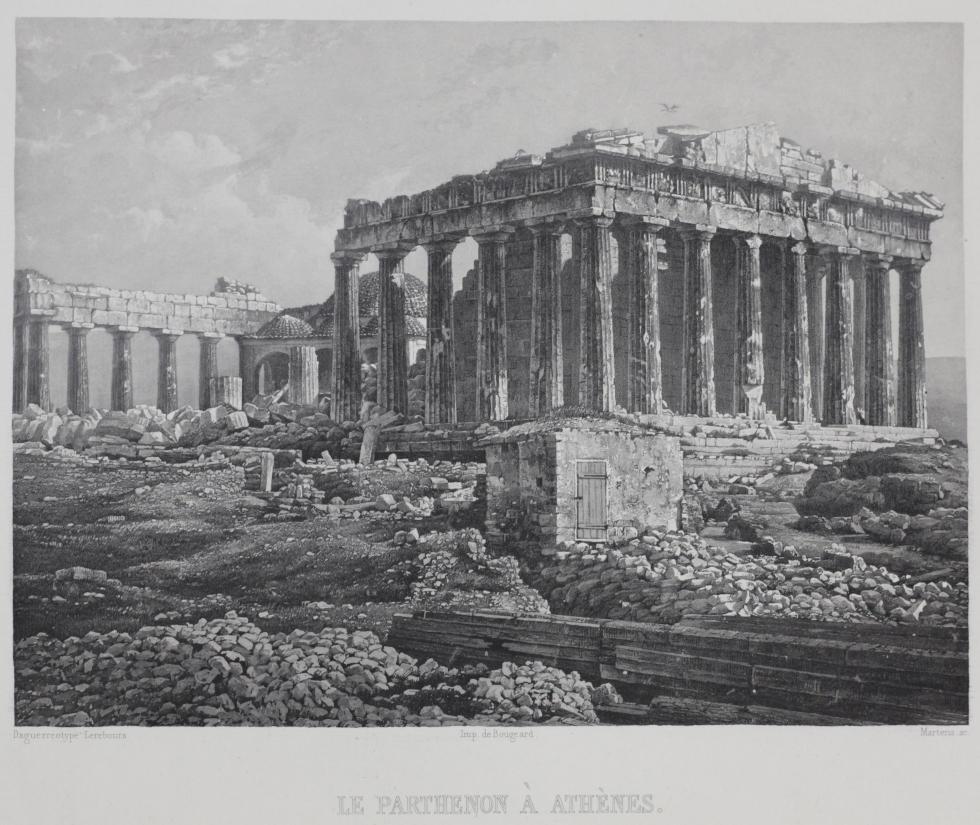
Above: The famous photograph of the Parthenon by Joly de Lotbinière showing the mosque with its dome in the open space. The mosque, build by the Ottomans, was demolished in 1843. Hence this is the only photograph and proof that there was a mosque here once.
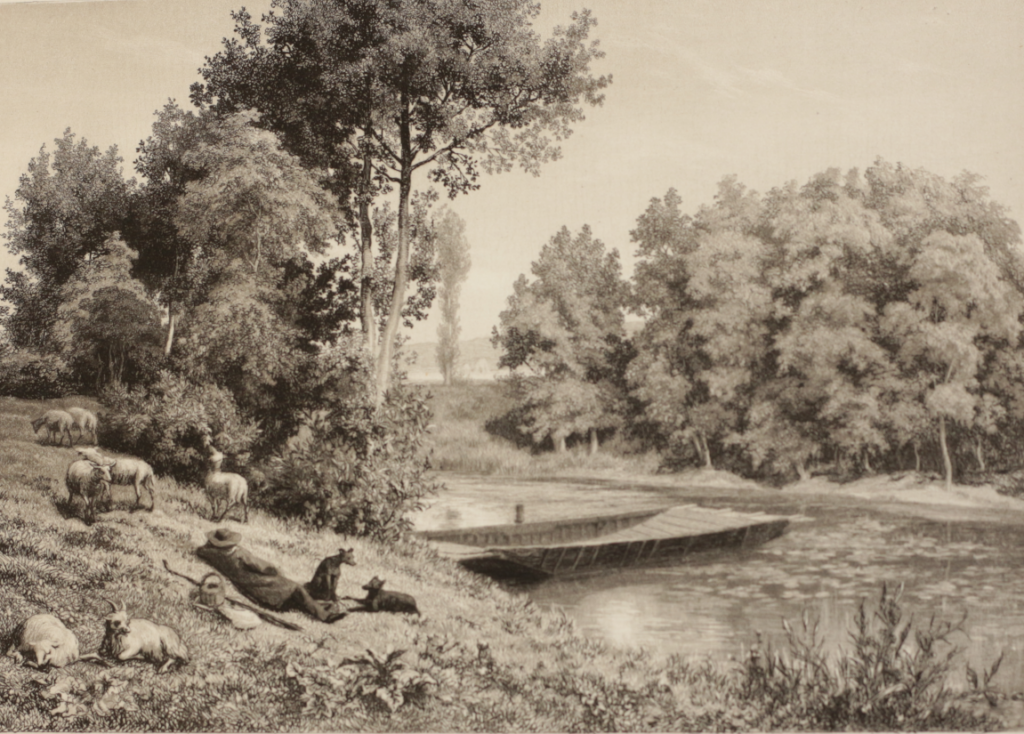
The view above “Vue prise à Bas-Meudon” is one of the very few landscapes without any building. It clearly reflects the late Romantic period.