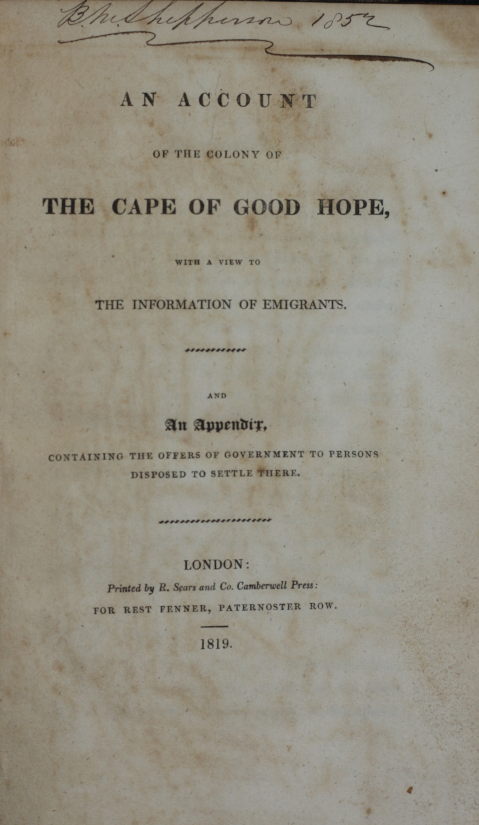
An Account of the Colony of the Cape of Good Hope, with a View to the Information of Emigrants.
Subtitled: And an Appendix containing the offers of Government to persons disposed to settle there.
Author: Curtis, Rev. C.G.
Year: 1819
Edition: First edition
Publisher: London: Rest Fenner
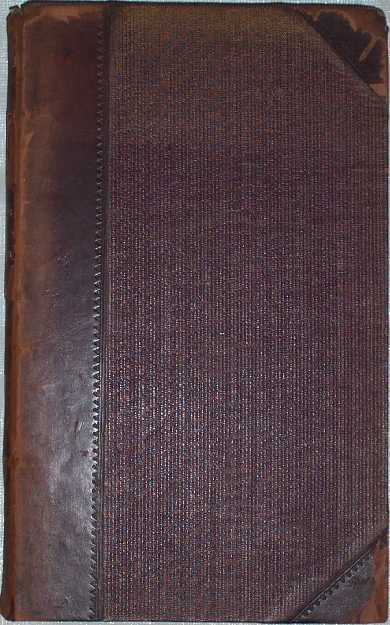
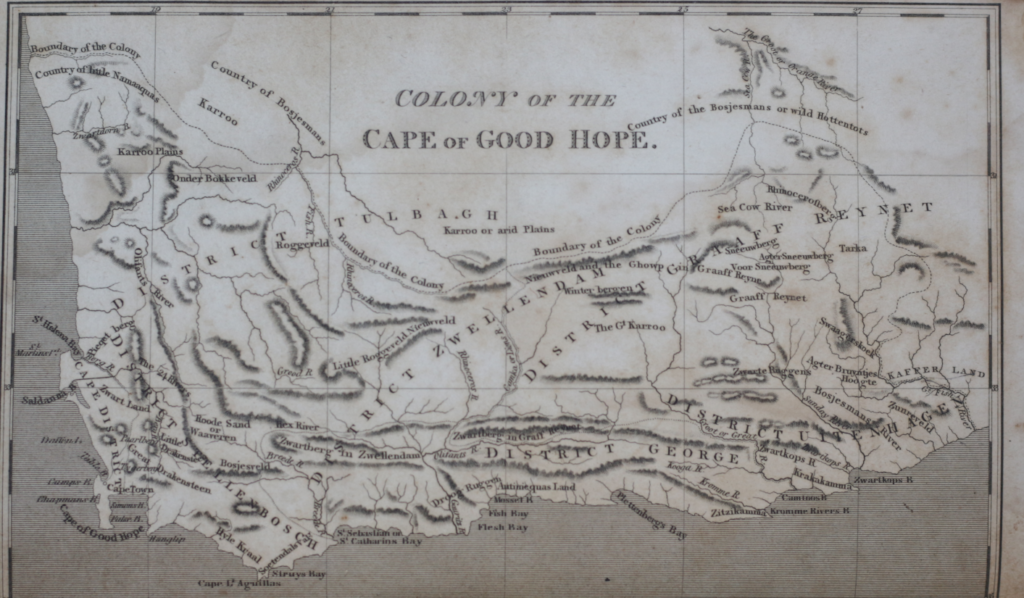
8vo, frontispiece map, pp. vi, 172. Later 19th century half calf over contemporary ribbed cloth with a chipped gilt title label on the spine, partially sunned at the top of both boards, some wear to extremities, spine rubbed, 218 x 135 mm. Some scattered foxing, lower part of final blank torn off, previous owner’s name on title page.
A compilation, giving an account of the Cape up to the date of publication. The population is given as 61,947, out of which 20,465 were whites, 25,754 were slaves and 14,447 were Khoisans, but the writer states that the Dutch seem to have attempted to make a line of demarcation between their territory and that of the natives.
Mendelssohn: “There is a description of Cape Town and the surrounding country, its soil, climate, and productions, the author quoting largely from early writers. With regard to the Boers, it is remarked that ‘The Dutch system of governing this Colony was found to be exceedingly ill-contrived and badly executed, . . . and that the agents of the administrations always favouring their brother Boers, crimes of every kind were committed within a few miles of the Cape,’ and it is stated that, with regard to many of the Boers, ‘unrestrained passions of all descriptions disgrace them from youth to age.’ The author describes the young ladies of the Cape as ‘elegant in form and easy in their manners,’ but characterises the young men as ‘lumpish and awkward.’
With regard to the slave question, it is asserted that ‘the whole system is a disgrace and incumbrance to the Colony.’ “
There is a long and interesting description of the Khoisan, of which he extensively describes their customs, weapons and their way of living and another description of the slaves. The volume contains many useful tables of statistics regarding agriculture, including vineyards, cattle, species of useful wood, etc.
Although published anonymously, the work is attributed by Mendelssohn to Rev. Curtis.
An interesting, important and very rare book on South Africa.
When the Dutch Republic was occupied by the French in 1794, in 1795 the British took control over the Cape Colony, which had been under Dutch rule since the VOC established a trading post there in 1652. It was the only viable port en route to the East Indies.
Already in the extensive (about 3,500 entries) 1902 ‘Catalogue of books on Africa’ of the famous antiquarian bookdealer Francis Edwards this book, under entry nr. 2255, is described as ‘scarce’.
Mendelssohn I, p. 403. Not in Hosken.
Acquired from Christison Rare Books, Scottsville, South Africa, December 2005.
.
.
.