Mainly in the past bibliophiles marked their books with an ‘ex libris’, a bookplate that contained their name, often with a small picture showing who they were or what they did. Ususally it was glued on the front pastedown. Here below some examples with name and the title of the book in which they are found. All books without exception are first editions.
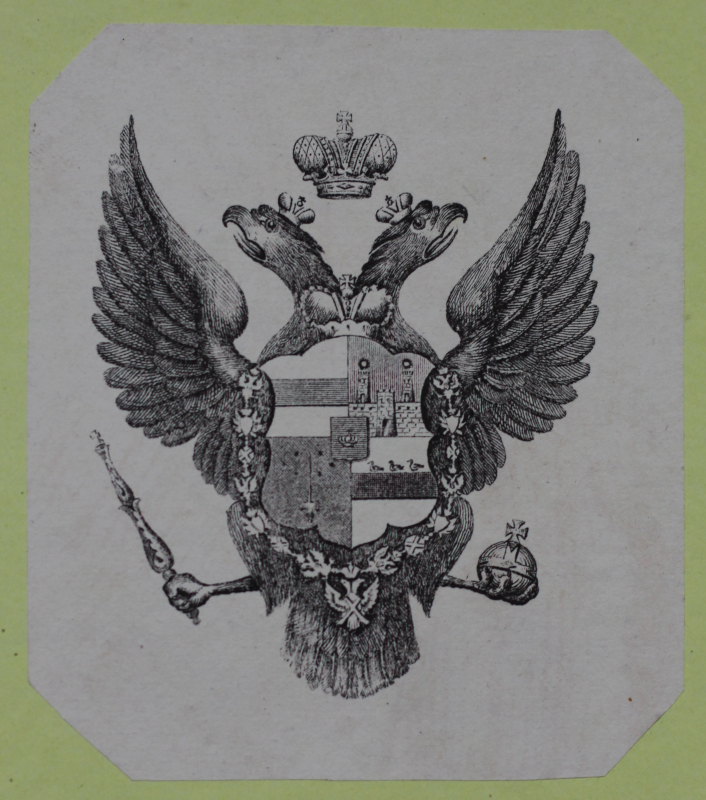
The bookplate of Maximilian Joseph Eugene Auguste Napoleon de Beauharnais, 3rd Duke of Leuchtenberg, Prince Romanowsky. He was a son in law of Tsar Nicholas the first of Russia and a cousin both of emperor Napoleon III of France and of Franz Joseph I, emperor of Austria and king of Hungary. (Book: Voyage en Perse. By Alexis Soltykoff.)
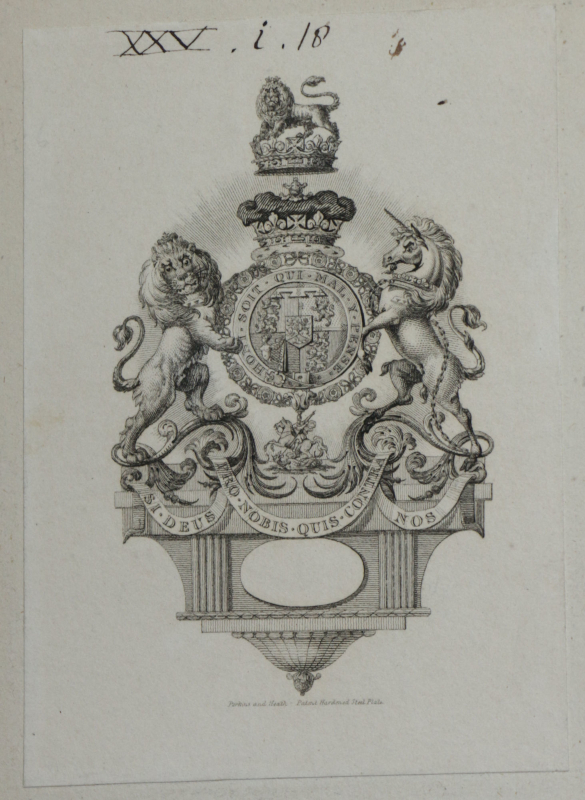
The bookplate of the first Duke of Sussex, a son of King George III. (Book: A True Historicall discourse of Muley Hamets rising to the three Kingdomes of Moruecos, Fes and Sus. The dis-vnion of the three Kingdomes by ciuill warre, kindled amongst his three ambitious Sonnes, Muley Sheck, Muley Boferes and Muley Sidan. The Religion and Policie of the More, or Barbarian. The aduentures of Sir Anthony Sherley, and diuers other English Gentlemen, in those Countries. With other Nouelties. By Robert Coverte [?])
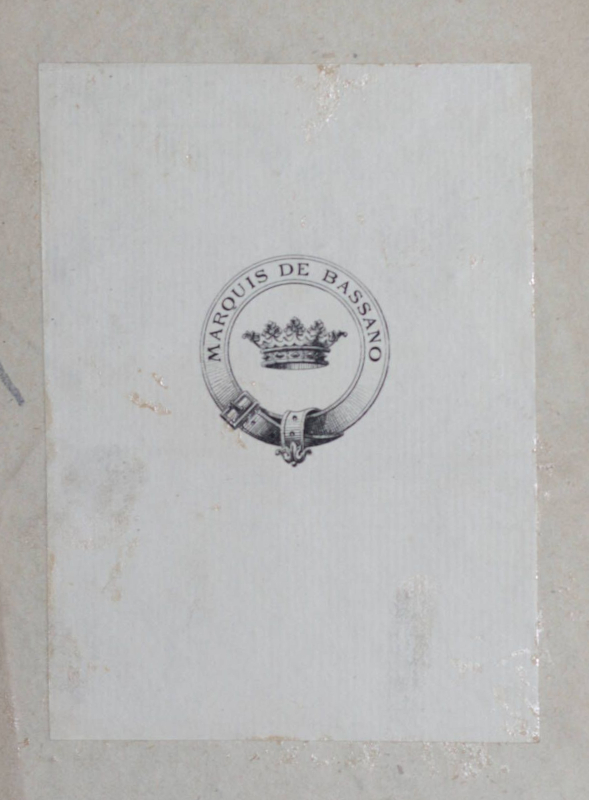
A peculiar bookplate of the Marquis de Bassano; Hugues-Bernard Maret was knighted in 1809, at first het got the title of count and only two months later he was promoted Duke of Bassano. A marquess, however, seems to be untraceable. (Book: The Voyages, Dangerous Adventures And imminent Escapes of Captain Richard Falconer: containing the Laws, Customs, and Manners of the Indians in America; his Shipwrecks; his Marrying an Indian Wife; his narrow Escape from the Island of Dominico, &c. Intermix’d with The Voyages and Adventures of THOMAS RANDAL, of Cork, pilot; with his Shipwreck in the Baltick, being the only Man that escap’d: His being taken by the Indians of Virginia, &c: Written by Himself, now alive. Published anonymously, but is attributed to William Rufus Chetwood.)
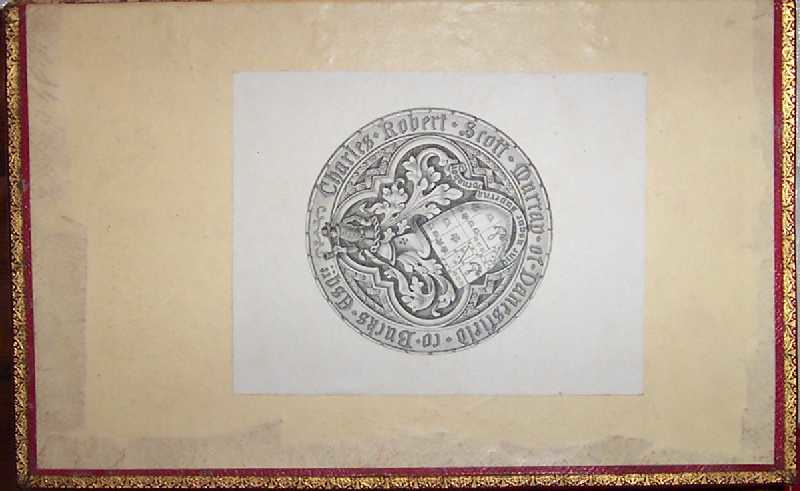
The bookplate of Charles Robert Scott-Murray of Danesfield, who has been a Member of Parliament for Buckinghamshire and later became High Sheriff of that county. (Book: Travels Through Central Africa to Timbuctoo; and Across the Great Desert, to Morocco, Performed in the Years 1824-1828. By René Caillié.)
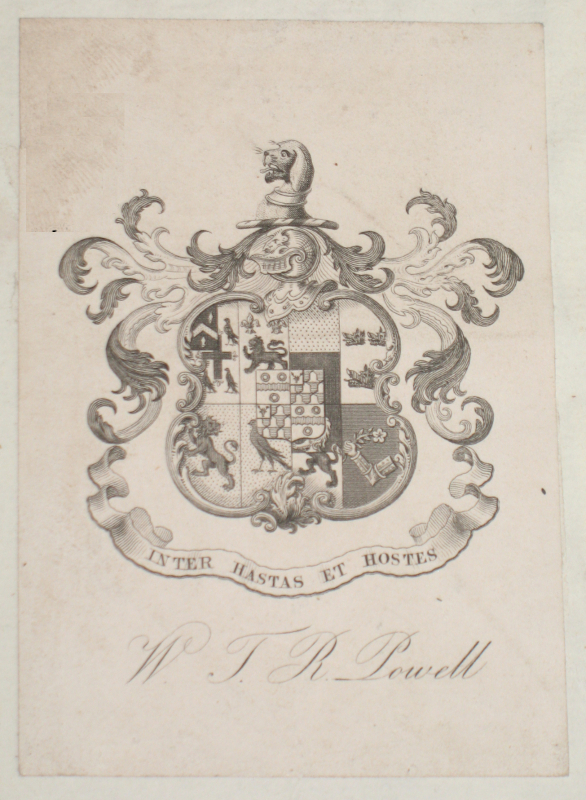
The armorial bookplate of William Thomas Rowland Powell (1815 – 1878) of Nanteos Mansion, Cardiganshire, with his motto “Inter hastas et hostes”. (Book: De Expedit. Alex. Magni, Historiarum Libri VIII, (bound with:) Arriani historici et philosophi Ponti Euxini & maris Erythraei Periplus, ad Adrianum Caesarem. By Flavius Arrianus.)
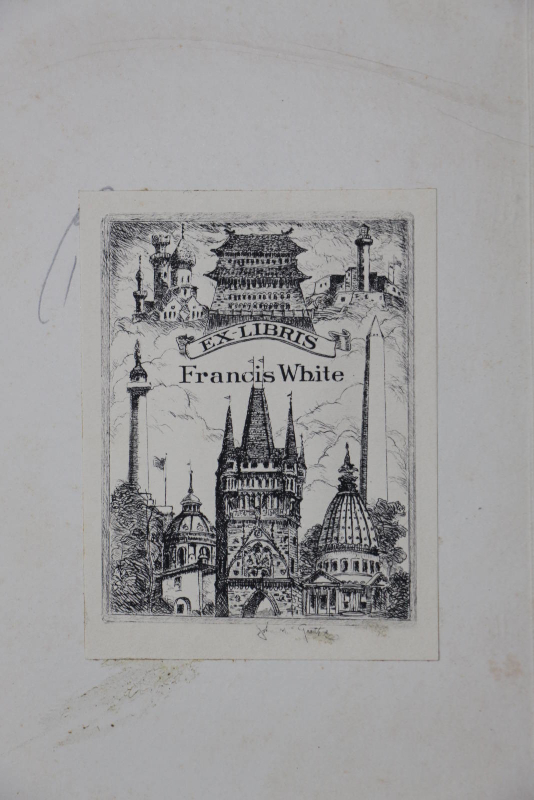
Bookplate of Francis White related to profession; Francis White spent many years on the Indian subcontinent including the Himalayas. (Book: History of Nepal, translated from the Parbatiya by Munshi Shew Shunker Singh and Pandit Shri Gunanand: with an introductory sketch of the country and people of Nepal. Edited by Daniel Wright.)
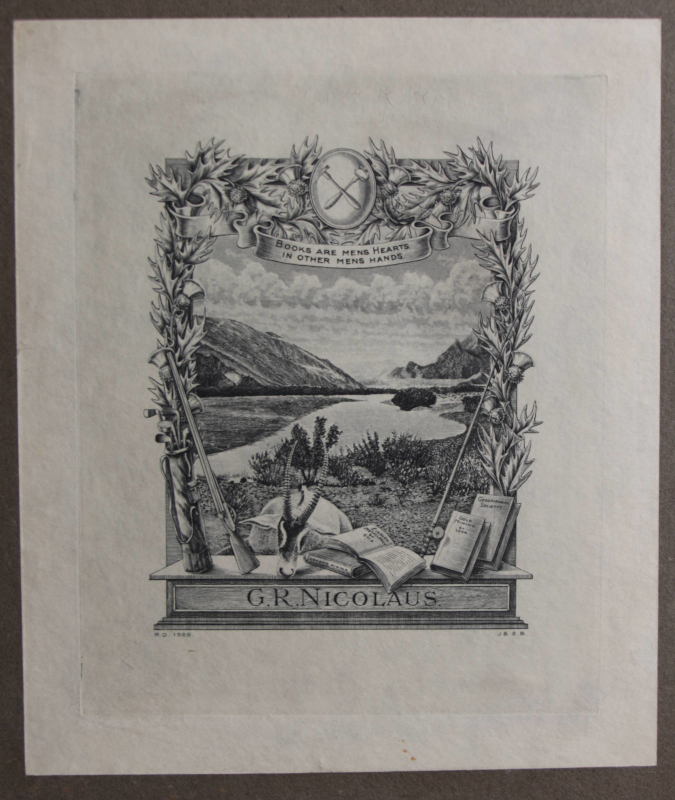
Bookplate of G.R. Nicolaus, bibliophile and a big game hunter. (Book: Sketches representing the Native Tribes, Animals, and Scenery of Southern Africa, from Drawings made by the late Mr. Samuel Daniell, engraved by William Daniell.)
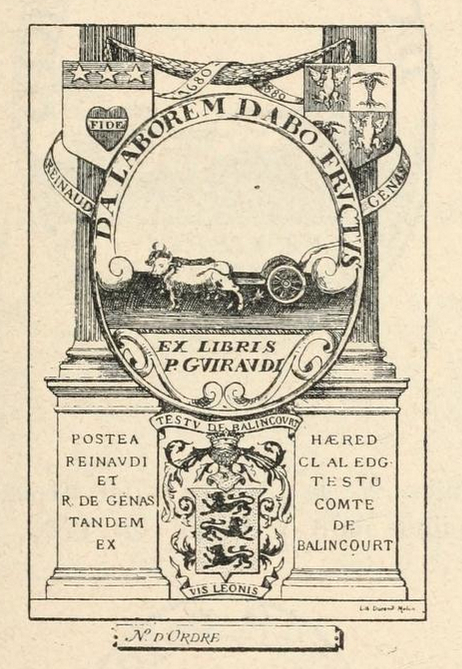
A bookplate that is often considered the be the bookplate of Pierre Guiraud, but it is a more complicated bookplate. It was lithographed by Durand and is exceptional in the way that it combines the coat of arms of the counts of Balincourt with the names of the people that, by inheritance, contributed to the collection of Edgard Testu comte de Balincourt. The basis for the collection was laid by Pierre Guiraud (born in 1656) who bequeathed it to Jean Maurice Reinaud (1706 – 1792). The next owner was Jean Jacques Maurice Reinaud de Gênas who left his collection to Edgard Testu de Balincourt (1832 – 1914). The latter was the one who designed this bookplate with at the upper side the original bookplate of Pierre Guiraud with his motto “Da laborem dabo fructus” combined with parts of the bookplates of the other two previous owners and at the lower side the coat of arms of the counts of Balincourt. At the top it reads “1680 – 1880”. The first year refers to the marriage of Marguerite Guiraud, sister of Pierre Guiraud, with Jean Maurice Fauquier while in 1880 this bookplate was designed by Edgard Testu. (Book: Traitté qui contient la methode la plus facile et la plus asseurée pour convertir ceux qui se sont separez de l’Eglise. By Cardinal de Richelieu.