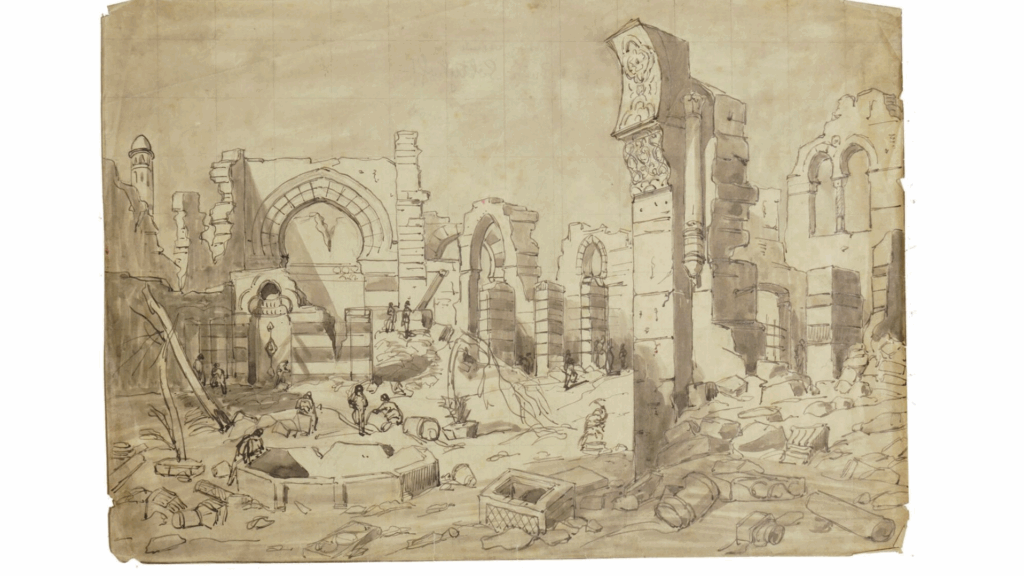
Picture above drawn on calculation paper.
After having spent a few months in Tehran prince Alexis Soltykoff returned to St. Petersburg via Tblisi (Tiflis). However, he did not travel to Tblisi directly, but first visited Tabriz (Tauris), See ‘Voyage en Perse’, pg. 110.
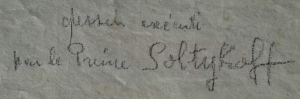
On the reverse side of this drawing there is written: “dessin exécuté par le prince Soltykoff”. Comparing this picture with the drawings made by travelers like Pascal-Xavier Coste (Bibliothèque de Marseille) and Eugène Flandin (a.o. British Museum) it is highly probable that the site depicted in this drawing is or was located in Tabriz, possibly the Arg-e Alishāh.
The style reflects a blend of Islamic and possibly pre-Islamic Persian architectural elements.
Islamic archways with pointed or rounded profiles, decorative geometric detail panels on columns, and the use of rubble and scattered remains are consistent with Tabriz’s historical mosque complexes.
The drawing shows large central/big arches, very heavy stone piers and it shows an octagonal or polygonal basin in front, while we know that the Arg-e Alishāh was organized around very large iwans and a vast courtyard.
Further the drawing shows a tall vertical carved fragment (right foreground) with vegetal/ornamental carving. Surviving fragments and drawings of Arg/Ilkhanid monuments often include carved stonework and ornamental fragments.
Given the information above we can conclude with almost 100% certainty that this drawing was made in situ in Tabriz and that it can be dated somwehere around february 1839.
.
.