Voyage en Orient: Voyage de la Syrie. Voyage de l’Asie Mineure.
Author: Laborde, Alexandre marquis de & Léon comte de
Year: 1837
Edition: First edition
Publisher: Paris; Firmin Didot
‘Voyage en Orient’ consists of two works, viz. ‘Voyage de la Syrie’ and ‘Voyage de l’Asie Mineure”, here bound together. Both works are rare and only very seldom found combined in one volume despite the fact that they were published simultaneously in a combination.
From the collection of Frederick August II, King of Saxony. Bookplate of the coat of arms with crown and printed text “Zur K.F. Sammlung F.A.II.” on the reverse of the title page.
Red morocco over paper covered boards, imperial folio; paper size 588 x 420 mm. The spine lettered and decorated in gilt.
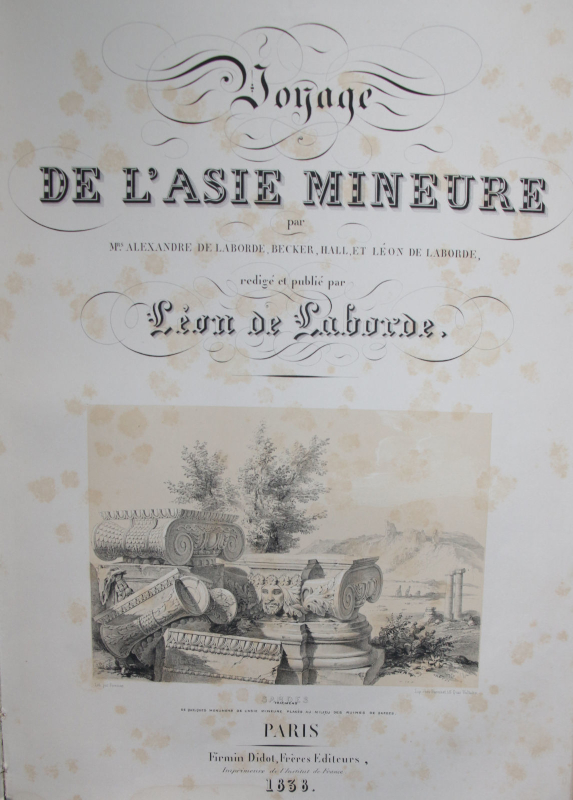
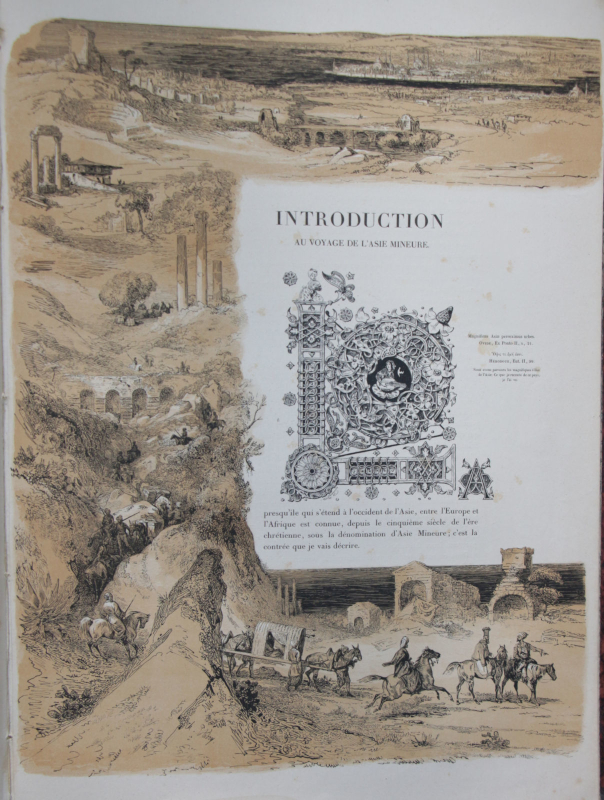
Two lithographed title pages with a vignet and two introductory pages. Per introductory page two historiated woodcut initials within borders by Fragonard, being the first leaves of the introduction text to both titles.
With 152 and 101 mostly tinted plates respectively on 66 (of 88, Voyage de la Syrie) + 48 (of 79, Voyage de l’Asie Mineure) leaves, of which respectively 4 and 2 leaves are finished by some degree of handcolouring. {1}
Of the last four plates of the second title one is a folding plate, two are double page panoramas and one is a double page plate with two panorama’s.
Collation Voyage de La Syrie:
Half Title
Explanation Frontispiece
Lithographed title page with fontispiece
Tipped in explication with bookplate underneath
Introduction with historiated woodcut initial, followed by 1 page of text only,
followed by the plates (in brackets nr. of plates per sheet, recto only, verso’s blank):
Aatil (2)
St. Antoine (2)
Beirou + Bechiza
Beirout (4)
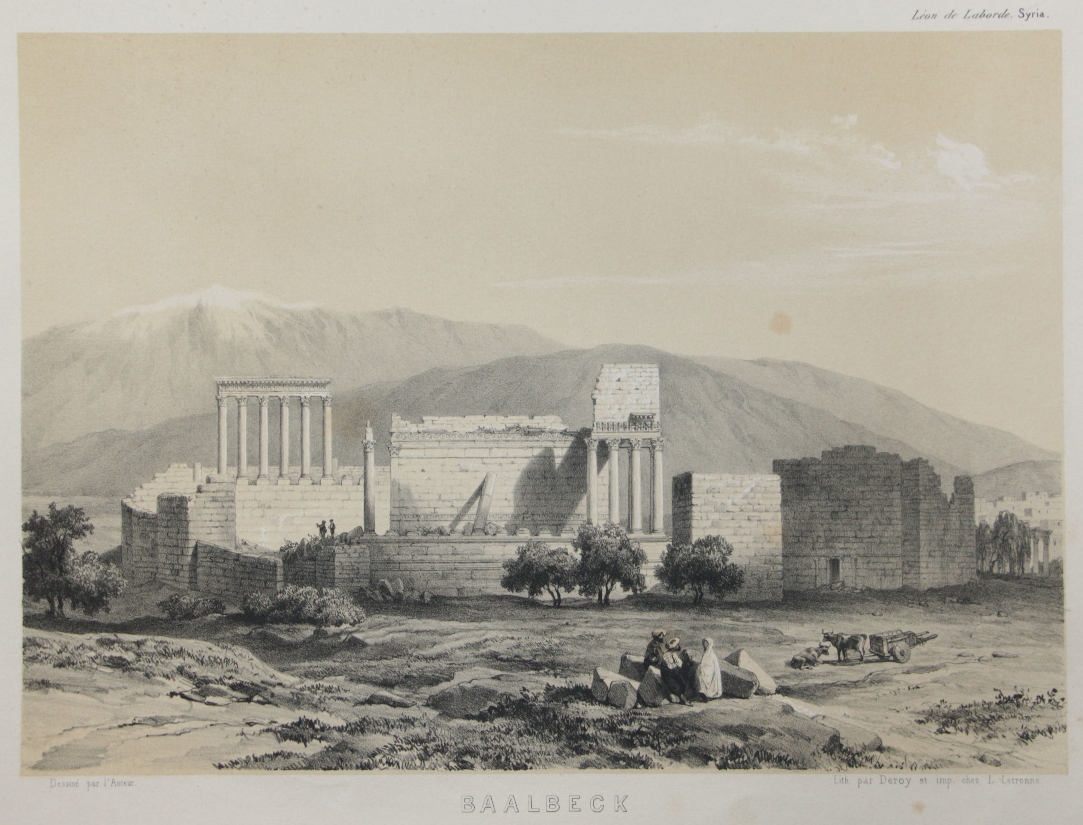
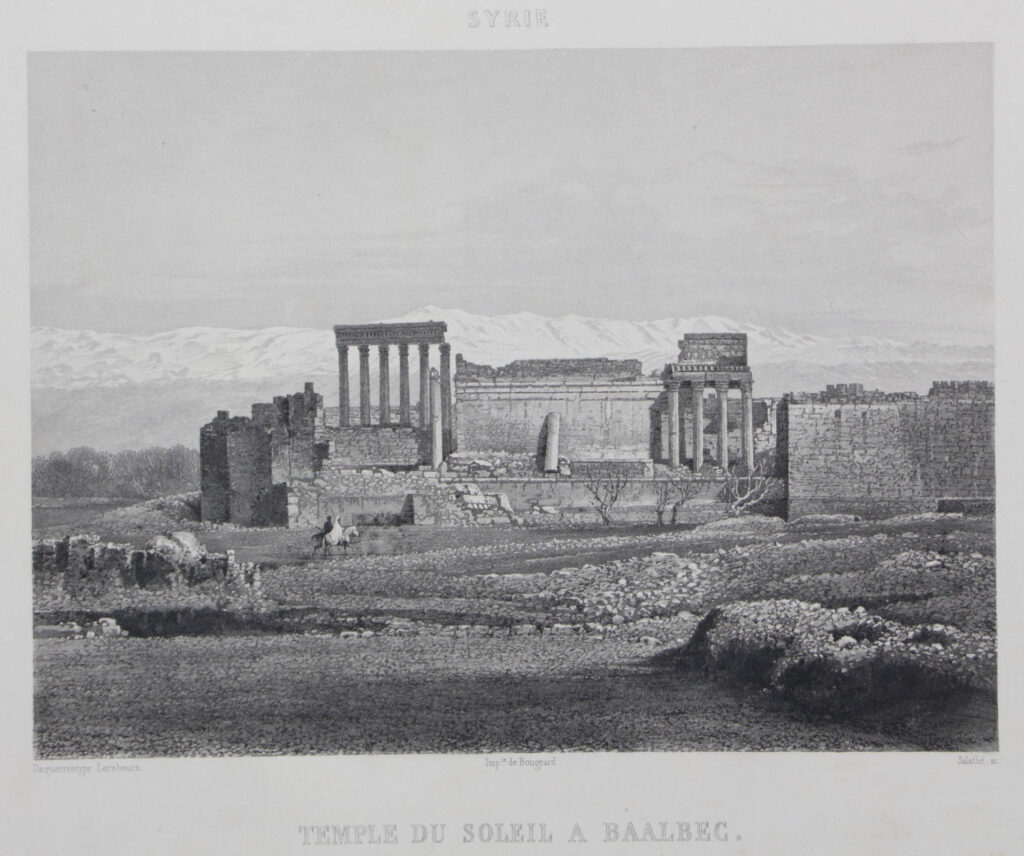
Baalbeck (2)
Baalbeck (2)
Baalbeck (2)
Baalbeck (2)
Baalbeck (2)
Baalbeck (2)
Bostra (2)
Bostra (2)
Bostra (2)
Canouat (2)
Cana (2)
Chypre (2)
Chypre (2)
Choba (2)
Damas (2)
Djerasch (2)
Djerasch (2)
Djerasch (2)
Djouni (2)
El Hosn (2)
Gaza + Hebron
Jerusalem (1)
Jerusalem (2)
Jerusalem (2)
Jerusalem (2)
Jerusalem (2)
Jerusalem (1)
Les cèdres de Salomon (1)
Liban (2)
Liban (2)
Liban (2)
Liban (3)
Liban (2) + St. Georgios (2)
Liban (4)
Hissemi (2)
Sebaste (2)
Sueda (2)
Nebbi-Djounis + Seide
Seide + Beyrout + Latakie + Sour (3)
Tartous (2)
Tartous (2)
Tiberias (2)
Tiberias (2)
Jourdain (2) + Tiberias
Tripolis (2)
Tripolis (2)
Florita + Tortose (3)
Karac + Tripolis
Kepse + el Okrah
St. Saba + Jericho
Jericho (coloured) + Damas (coloured)
Damas (coloured) + Halep (coloured)
Bosra (coloured) + Damas (coloured)
Damas + Ghor Meridionale
Scènes de Mceurs (6) (moeurs ?)
Alep (coloured) (2)
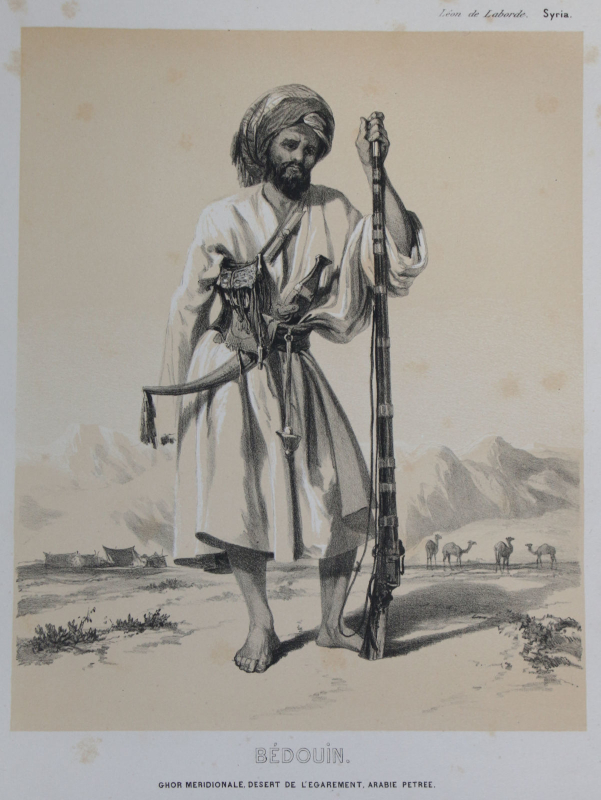
Bedouin (3)
Costumes Syriens (6)
Syrie (1)
Collation Voyage en Asie Mineure:
Title Page
Dedication page (from Leon de Laborde to his father Alexandre de Laborde)
Explication
Introduction with historiated woodcut initial followed by 1 page of text only,
followed by the plates (in brackets nr. of plates per sheet, recto only, verso’s blank):
Docanlou (2)
Docanlou (2)
Docanlou (4)
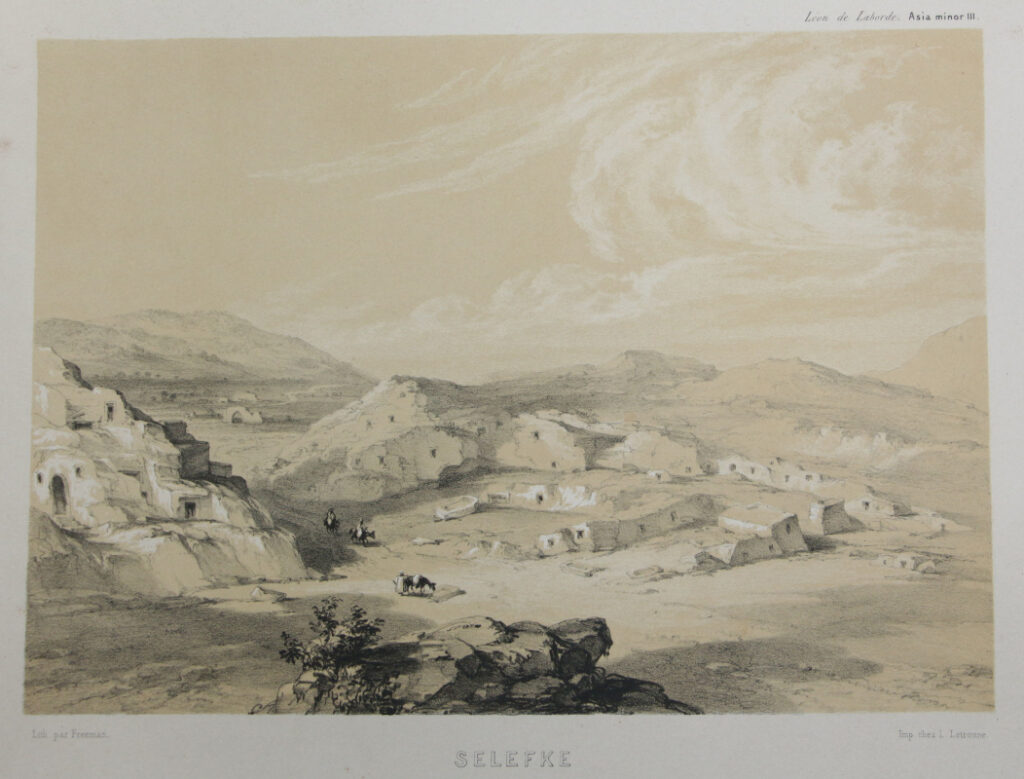
Selefke + Plan de Selefke
Ayach (2)
Ayasch (2)
Bouldroun (2)
Sabandja (3)
Sabandja (2)
Méandre + Constantinople
Tchavdère (2)
Tchavdère (2)
Tchavdère + Plan de Tchavdère
Tchavdère (2)
Pamboukkalesi (2)
Pambouk-kalesi + Plan de Pamboukkalesi (Hierapolis)
Pamboukkalesi (2)
Pamboukkalesi (2)
Konieh – Le Caire (2)
Tarsous (2)
Tarsous (2)
Pompeiopolis (2)
Pompeiopolis (2)
Bechiza (2)
Konieh (2)
Konieh (2)
Constantinople (coloured) + Caramanie (coloured)
Constantinople (coloured) + Sardes (coloured)
Eerdir (2)
Afioum-Carahissar (2)
Zumbat – Kalessi (2)
Gallus + Chougout (3)
Gueira (2)
Koumbet + Kosref Pacha Khan
Isbarteh (2)
Smyrne (3)
Smyrne (2)
Ephèse (2)
Taurus (2)
Afioum Karahissar + Arras + Caramanie + Yalovatch
Madenscher (2)
Madenscher (2)
Taurus (2)
Panorama (1) (double page)
d’Ephèse (1) (double page)
Panorama de Teos (1) (foldout)
Ruines de Temple d’Appolion (2) (double page)
Apart from the 2 pages of text on the versos of the historiated woodcut initials no further text pages, as often.
Some spotting in various degrees throughout, heavier on a few leaves, while other leaves are (almost) clean. A few leaves with an unobtrusive dampstain in the lower margin.
First, in 1827 in the company of his father, he travelled via Florence, Rome, Naples and Otranto to the Levant; Corfu, Constantinople, Jerusalem and Alexandria. Later, after his father had returned home, he explored the valley of the Nile and Jordania.
From 1837 onwards these two books were published in installments, under the title ‘Voyage en Orient’, 36 installments in total at a price of Ffr. 12,- each. It was up to the subscribers to divide these installments into two folio volumes; one for Asia Minor, the other for Syria including the Lebanon and Palestine. According to the Journal Général de la Littérature de France the first installment was for ‘Voyage de la Syrie’, while installments 2 ~ 4 all were for ‘Voyage de l’Asie Mineure’.
Because of the way of publication complete copies of both works are extremely rare today.
Brunet mentions 40 installments with a total of 180 sheets, however, the work was completed with 167 sheets in 36 installments.
Of these combined two titles bound together there is no auction record in ABPC and just one in RBH: Christies, their London sales of June 3rd 2009 of ‘Valuable Printed Books and Manuscripts’.
Christies: A collection of plates, in the original sheets, for approximately half of both parts of Laborde’s ‘BEAUTIFULLY PRODUCED WORK (Blackmer). ABPC records no occasion of both parts being offered together at auction in over 30 years. Although they are typically found individually, L’Asie Mineure and Syrie were in fact issued together within the same parts, and subscribers would then divide the works for binding. … In the leaf of provisional text for Part III Laborde explains that the text for each work would only be published after all the plates had been issued; meanwhile subscribers were to refer to the leaf of provisional descriptions issued with each part. In the same place Laborde writes that he anticipates finishing one work before the other — which may explain why some bibliographies give 1845 and others 1861 as the completion date for this work. In the event, the subscriber of the present set appears to have lost patience about half-way through. Neither part in Atabey. Blackmer 931 (for Asia Minor), Brunet III, 714.
Apparently the king of Saxony lost his patience as well and had the incomplete parts bound together in a tome with an elaborately gilt tooled spine.
Biblio: Blackmer 931 (Asie Mineure), Brunet III – 714, Weber I, 278 (Asie Mineure). Not in Atabey.
Acquired from Auktionshaus Kiefer, their sale May 2020.
{1} Christies and Sotheby’s often, but not always, describe the partly coloured plates as: “… , a few with additional printed red and blue, …”, however, also as: ” A few plates in each partly coloured.” (Christies), or as: ” …, a few partly coloured by hand, … ” (Sotheby’s).
Sometimes also these few plates are described as “Additionally printed in red and blue, finished with some hand colouring.”
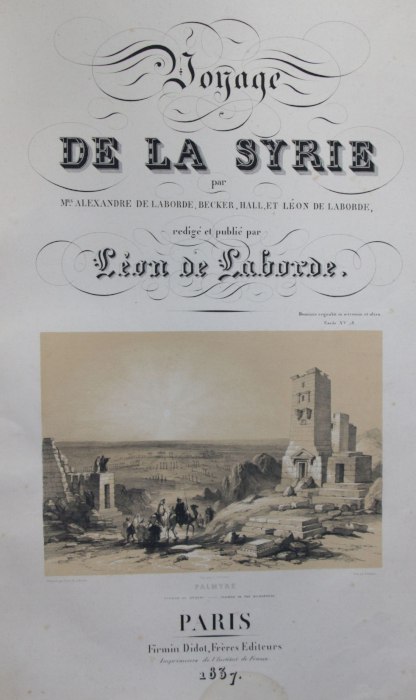
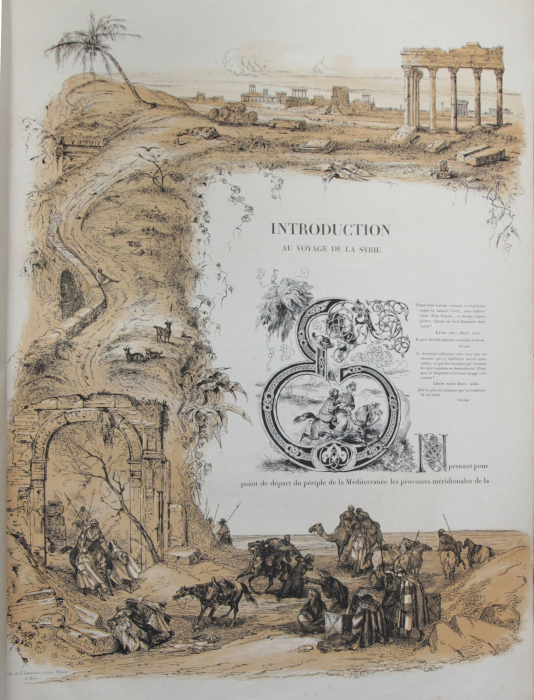
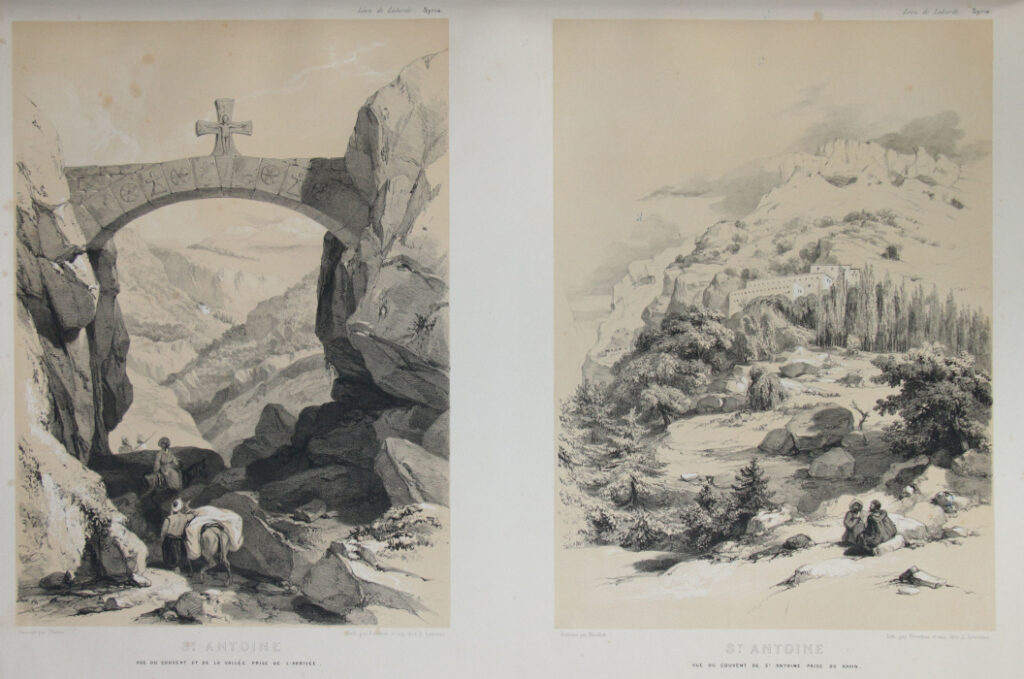
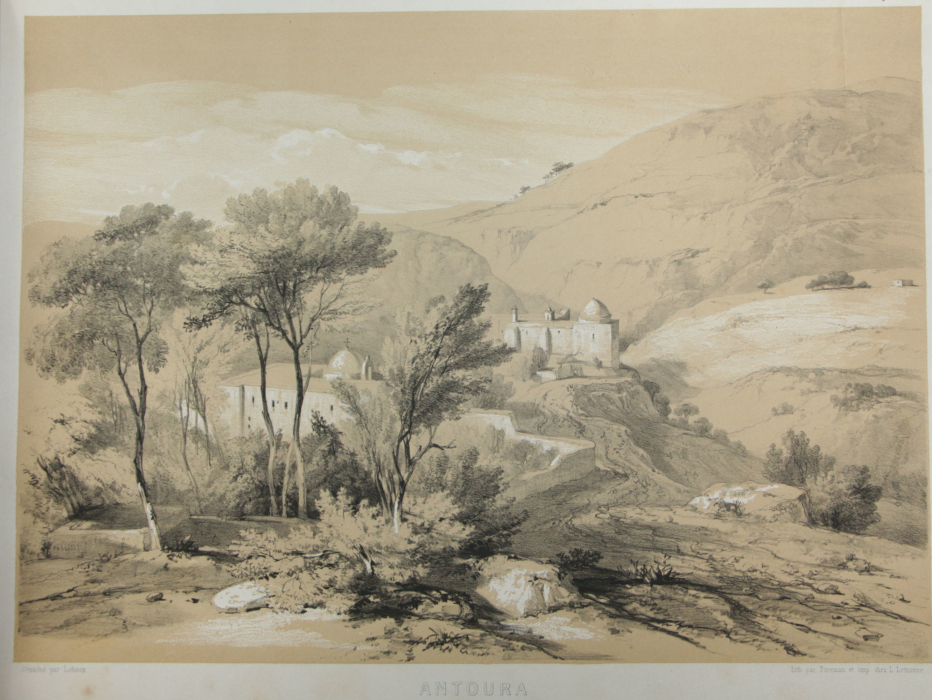
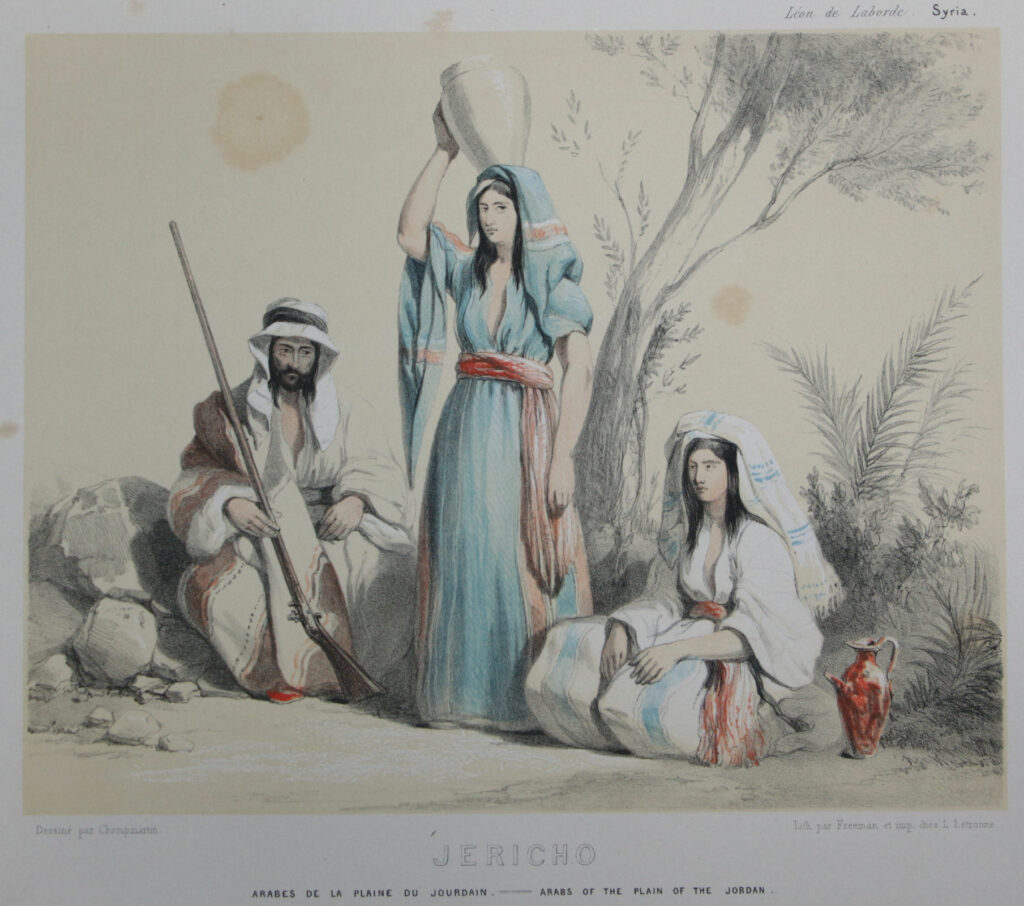
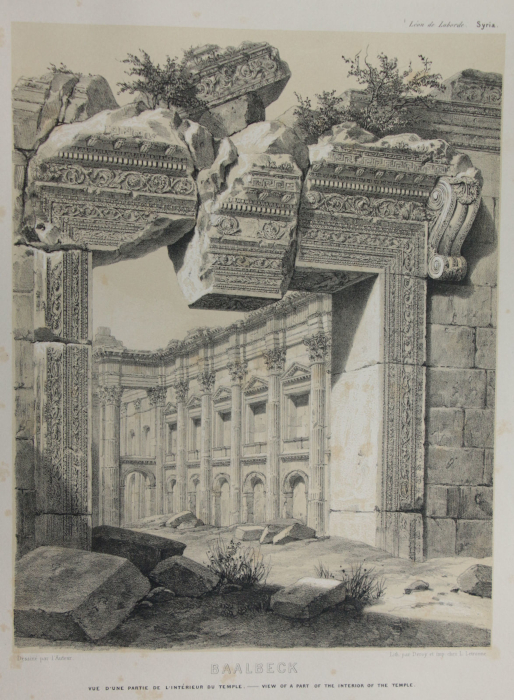
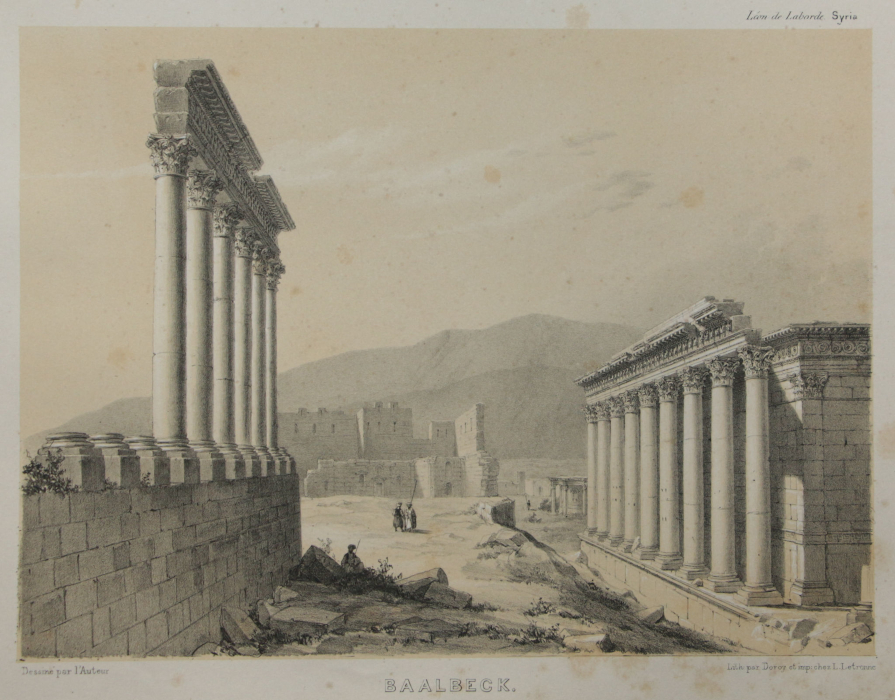
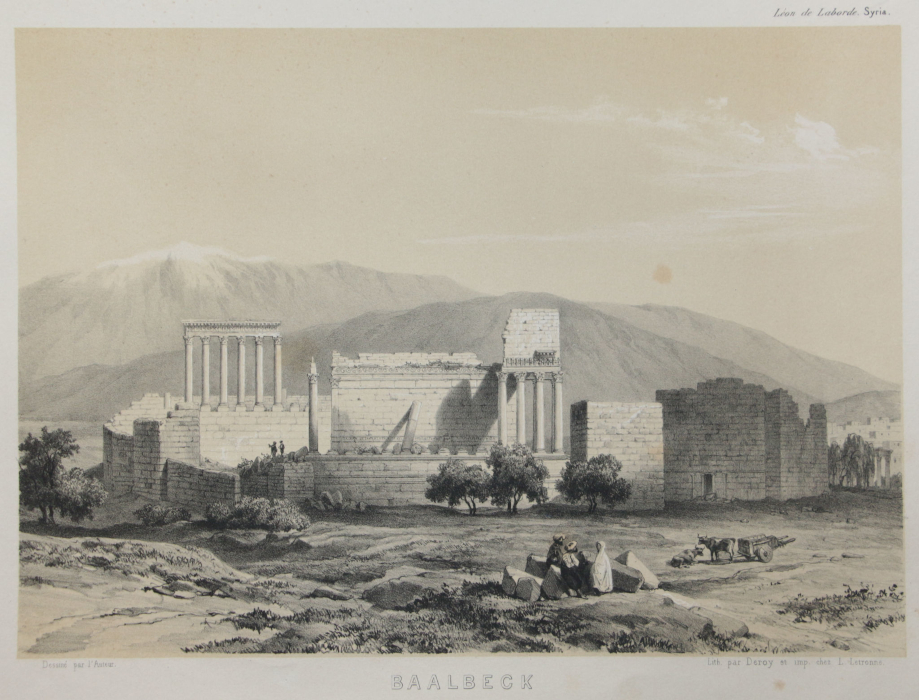
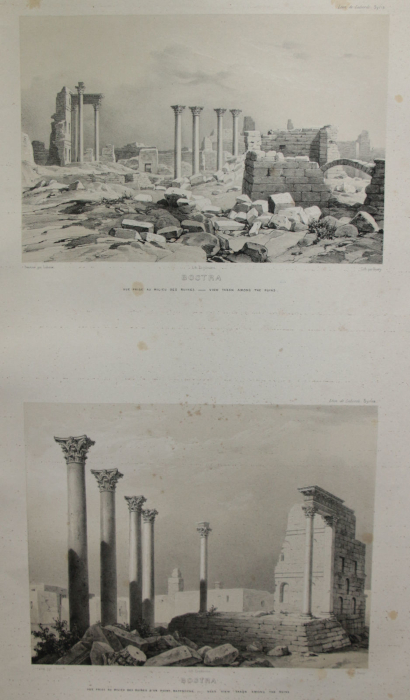
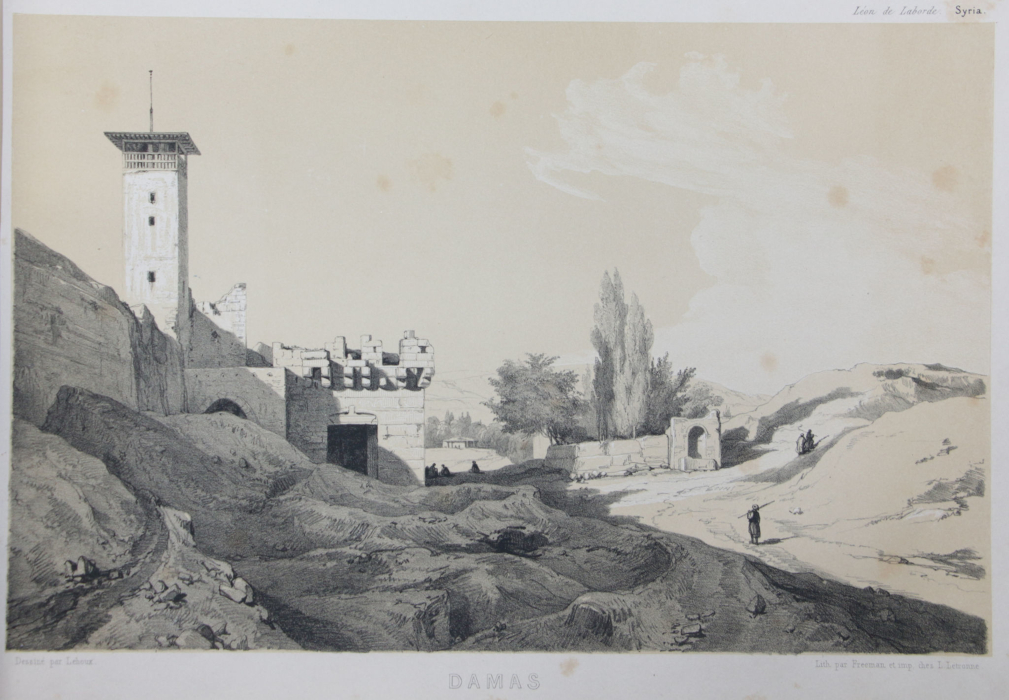
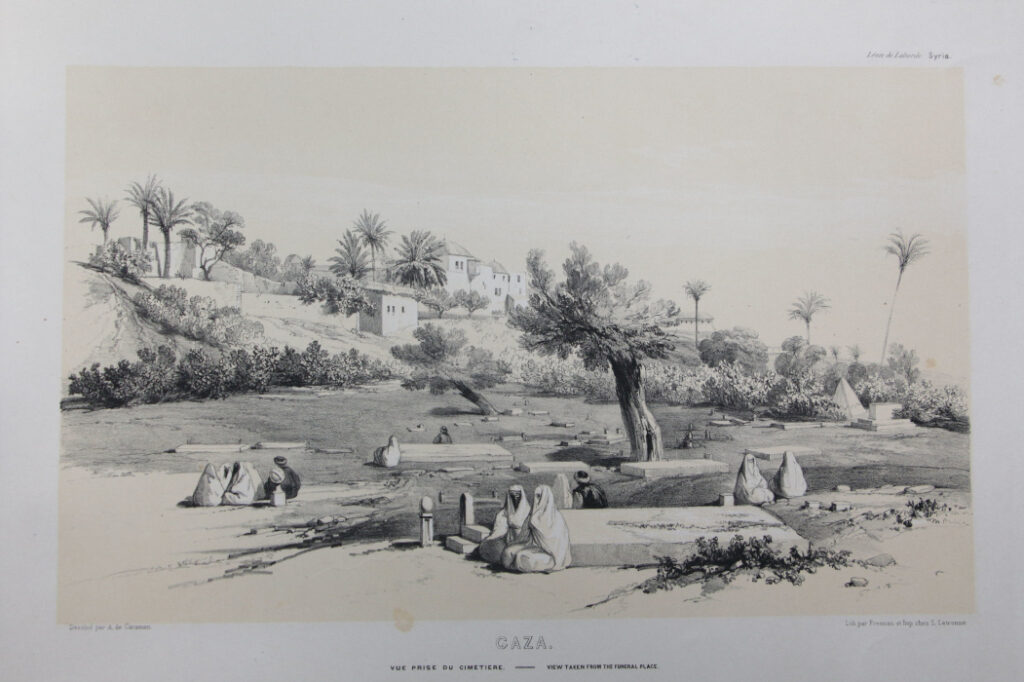
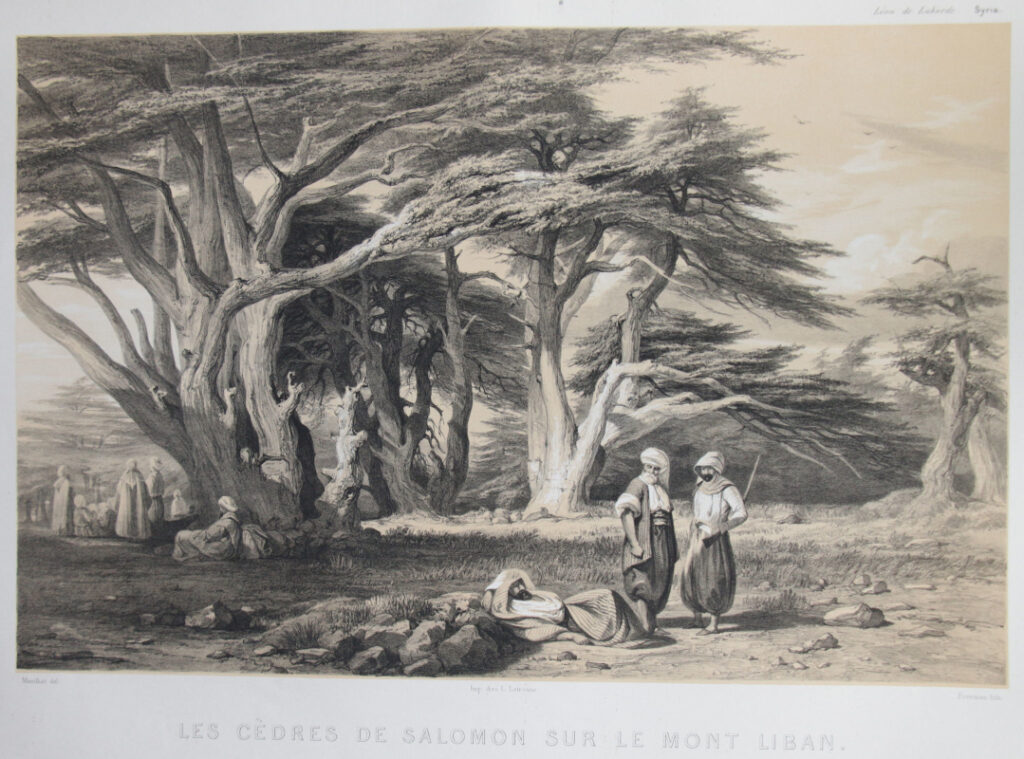
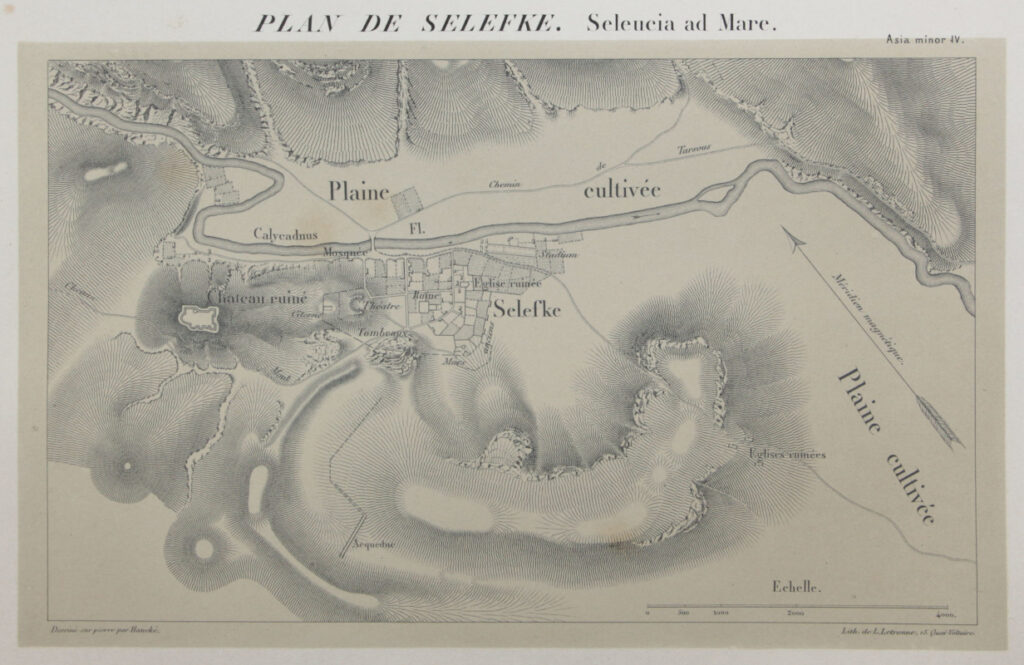
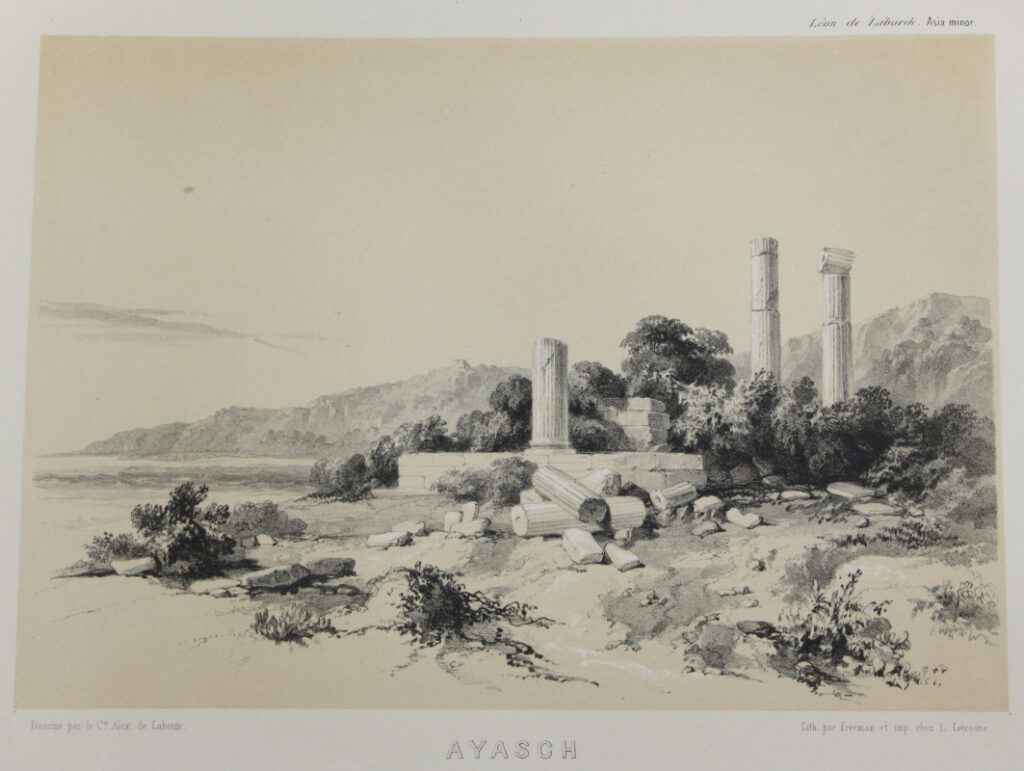
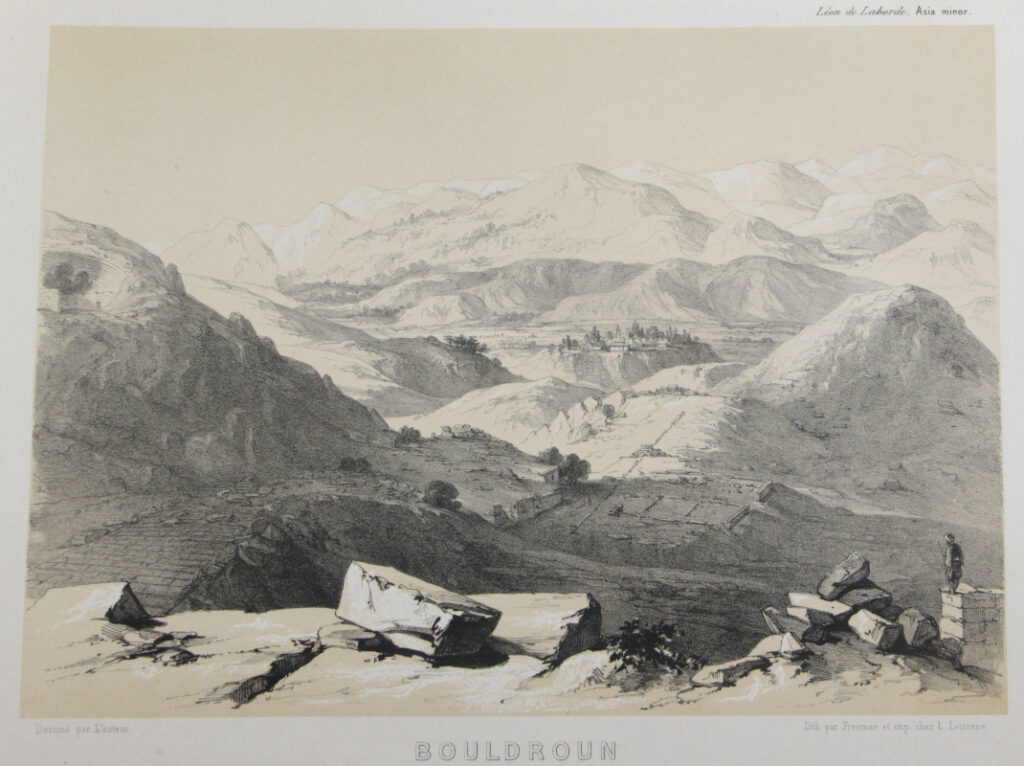
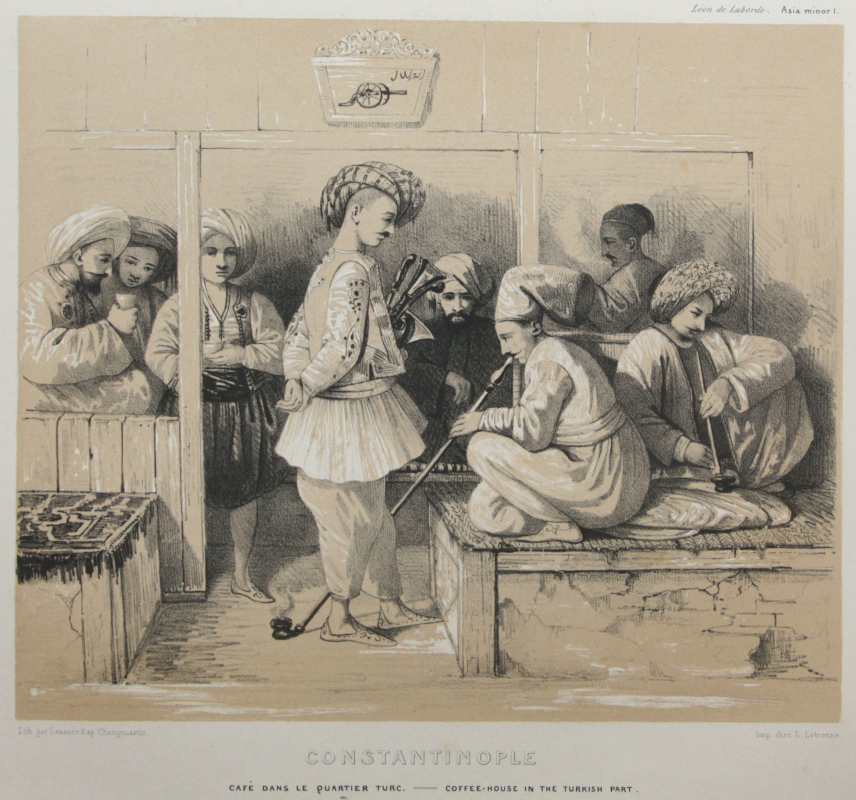
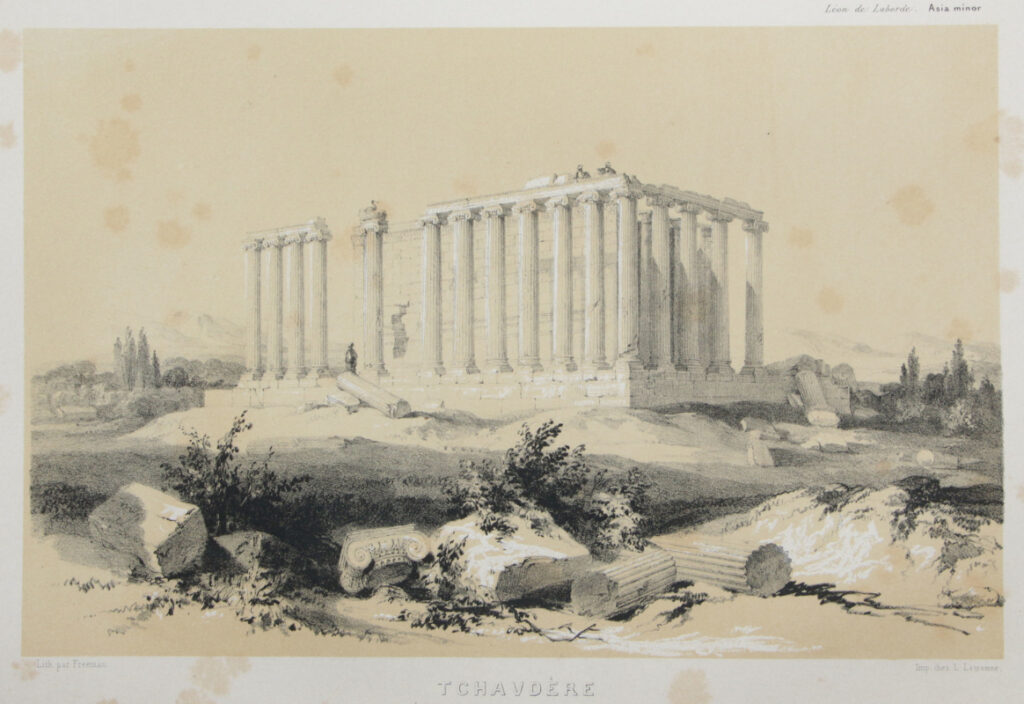
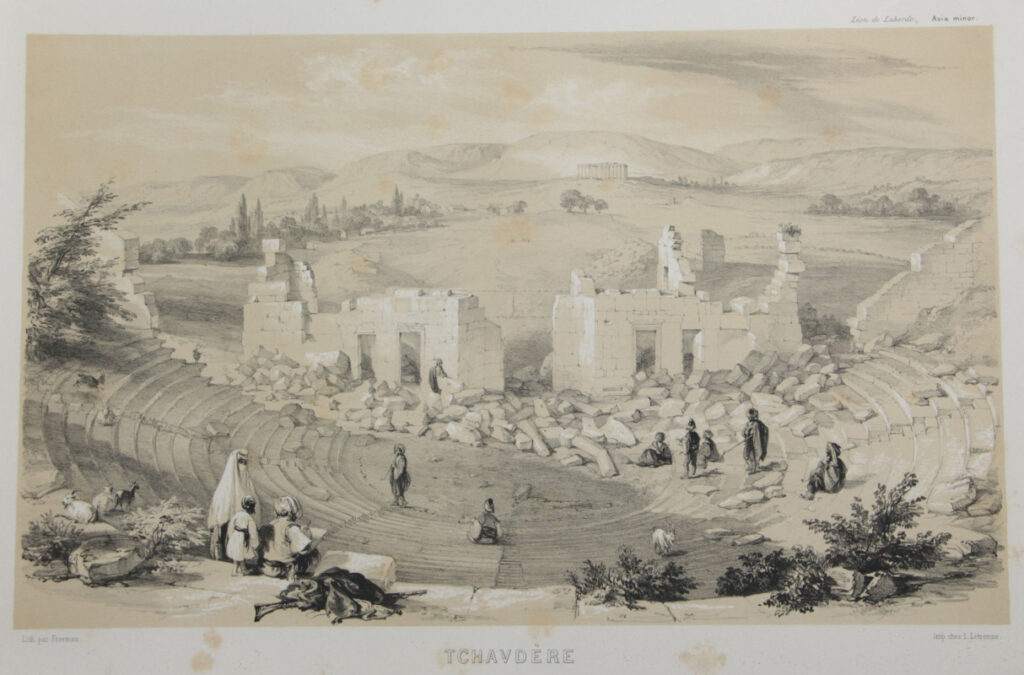
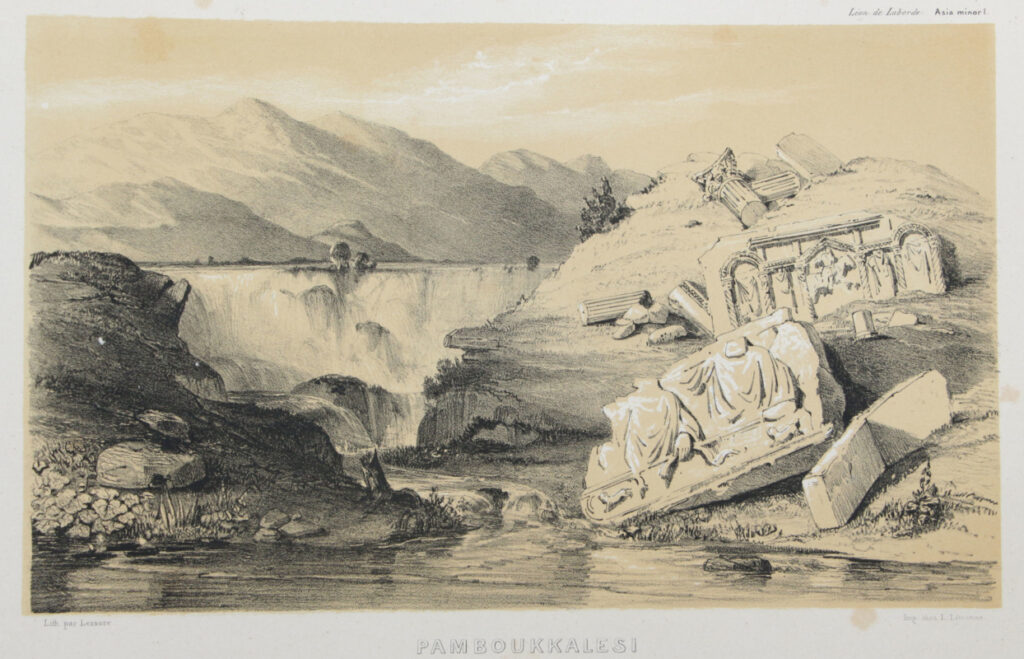
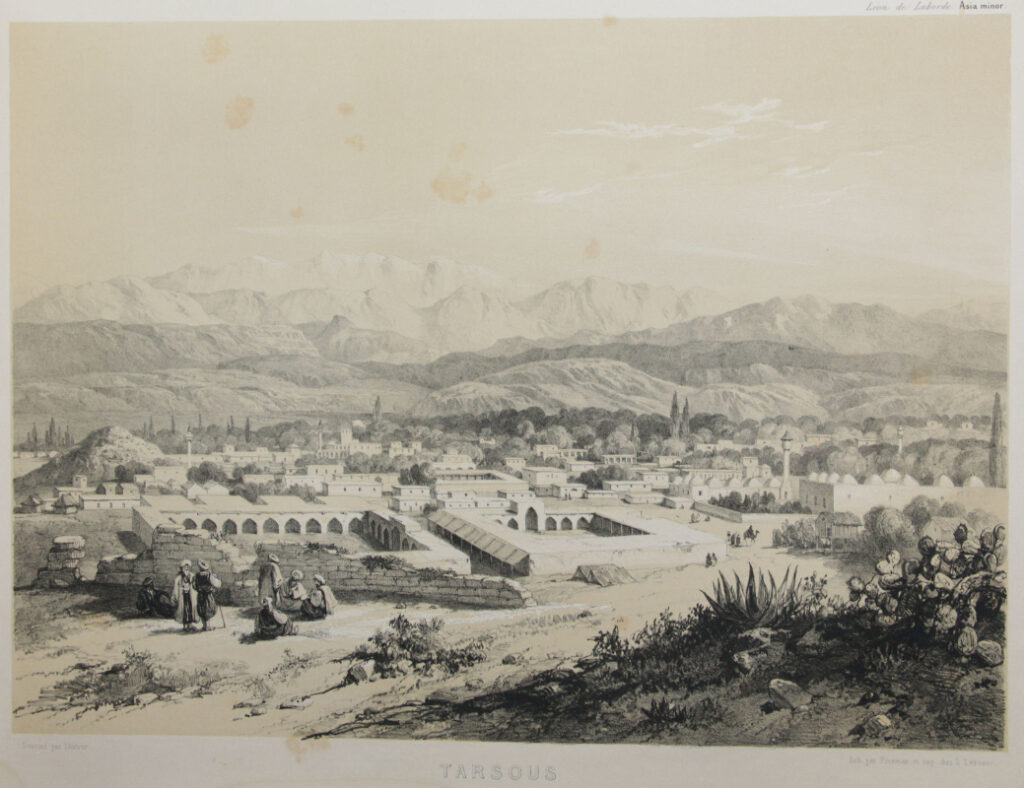
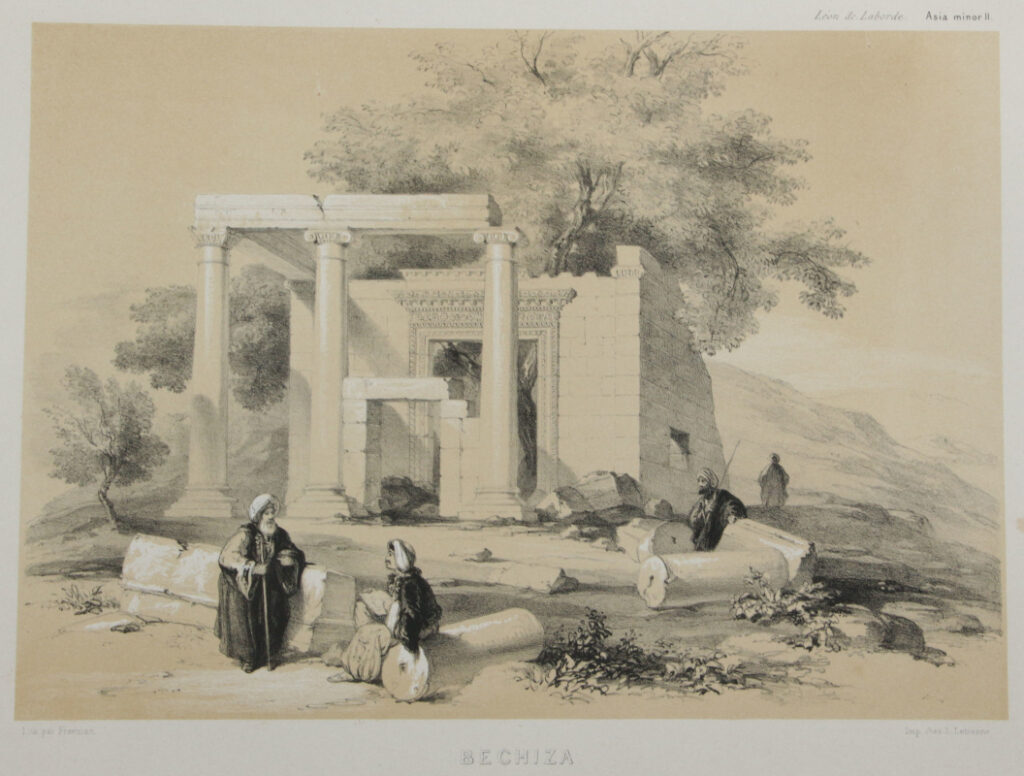
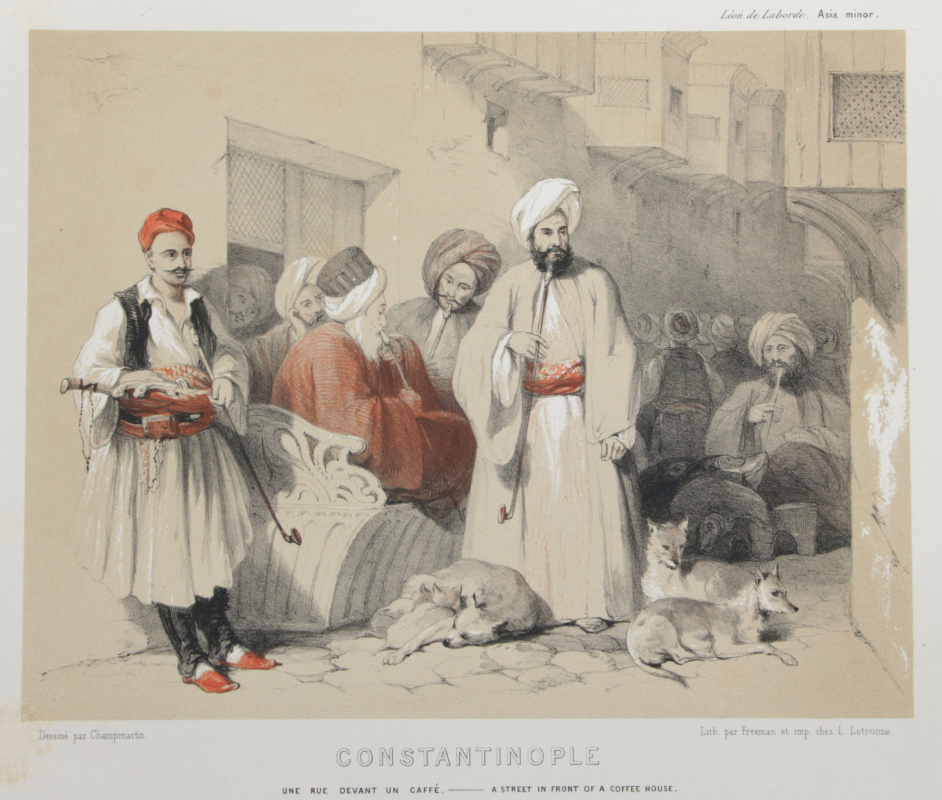
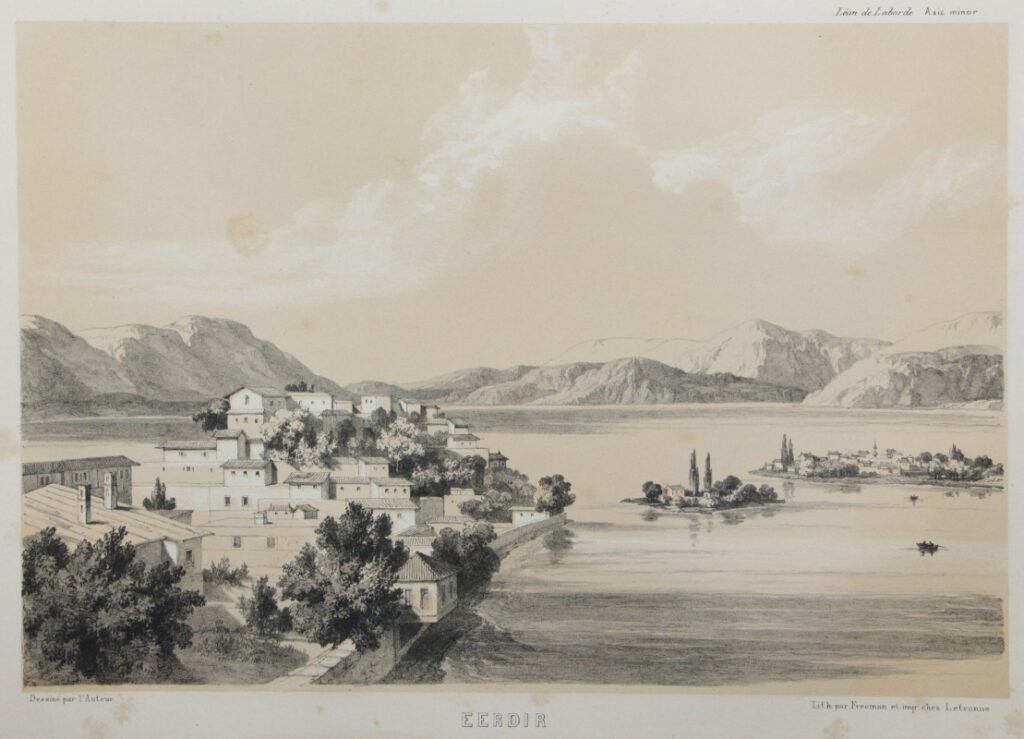
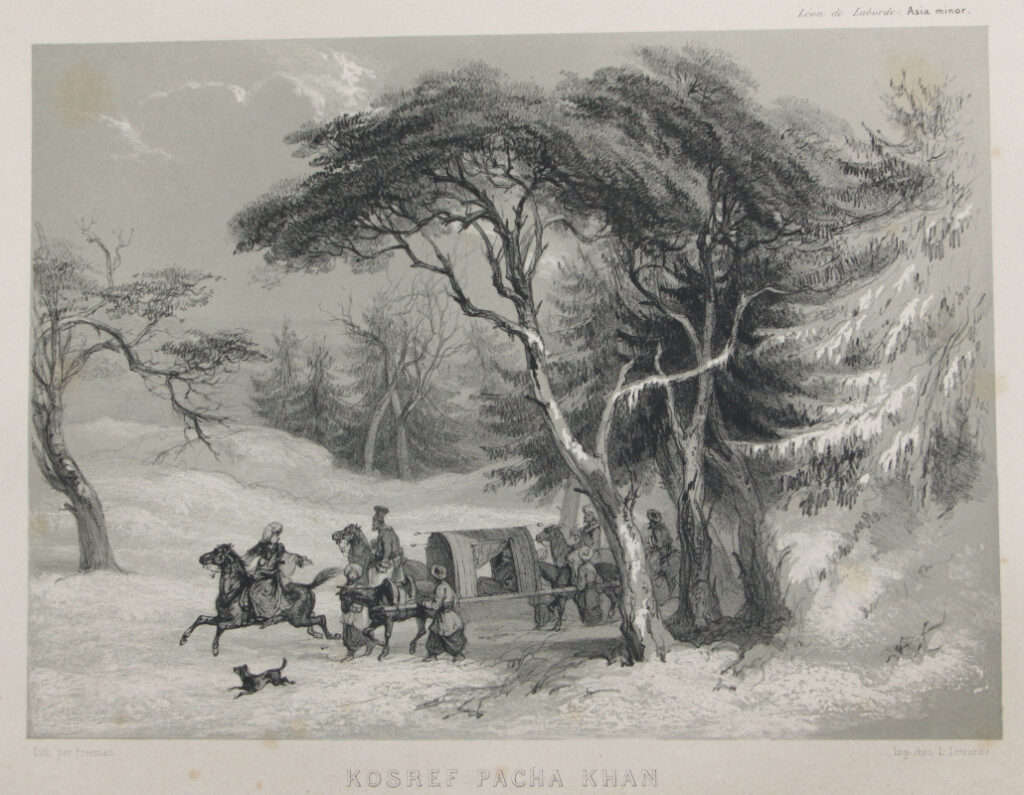
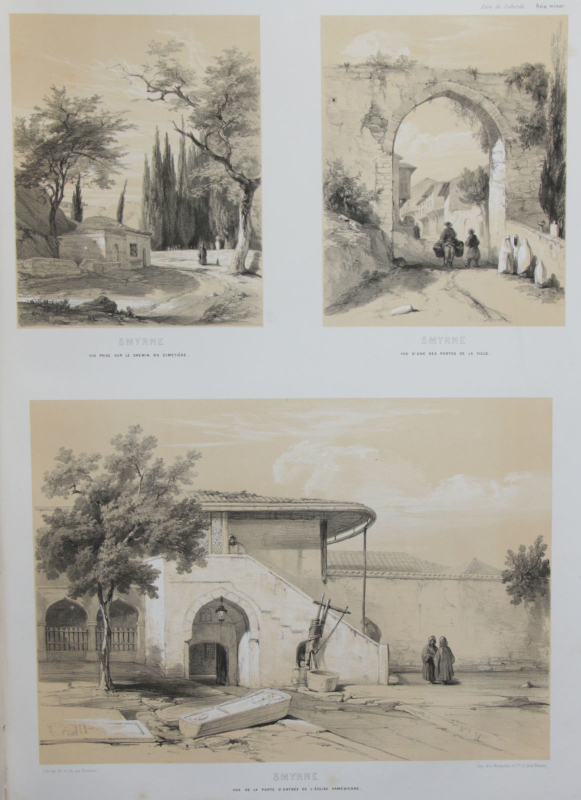
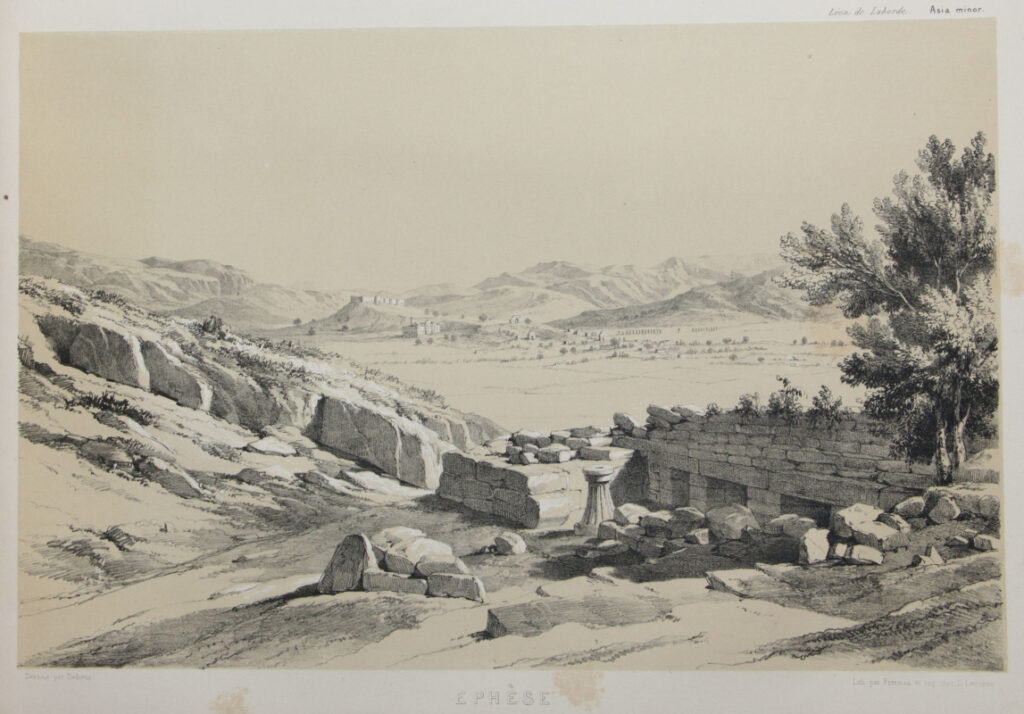
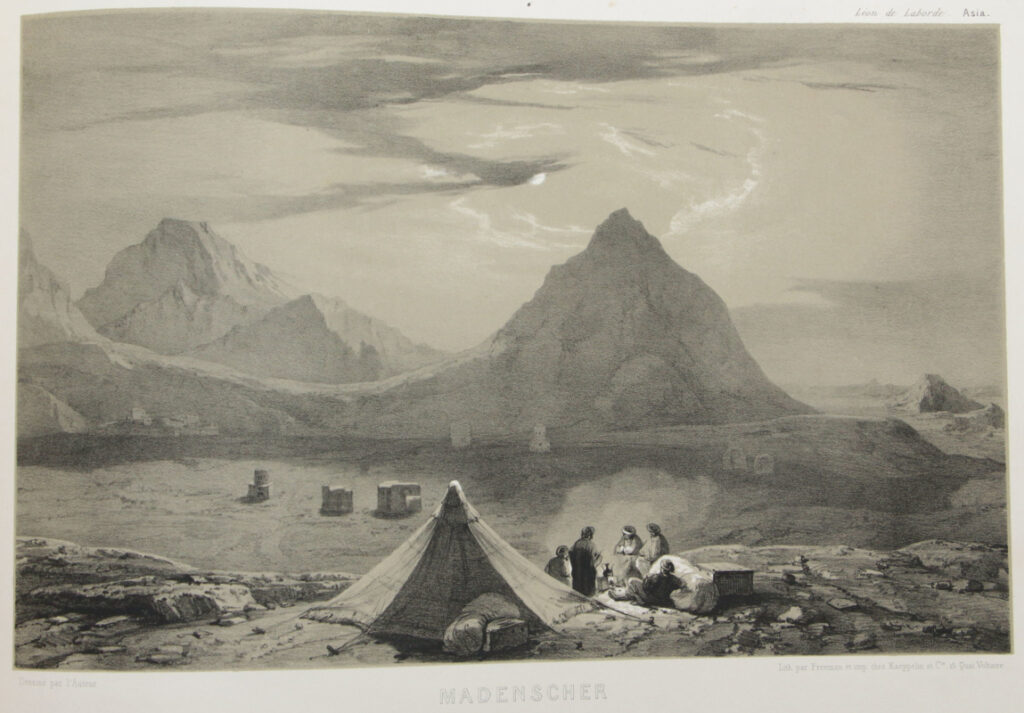
Short biography of Léon de Laborde in relation to his Voyage en Orient (AI generated)
Few figures in the history of European Orientalism combined the instincts of the artist, the scholar, and the adventurer quite as naturally as Léon de Laborde. Born in Paris in 1807 into an intellectually distinguished family, his father was the comte Alexandre de Laborde, author of the celebrated Itinéraire descriptif de l’Espagne, Léon grew up in an environment where travel, learning, and the visual record of distant places were taken entirely for granted. The journeys he undertook as a young man in the Near East, and the publications he subsequently drew from them, placed him at the forefront of European knowledge of the ancient and contemporary Levant. Of these publications, the Voyage en Orient — encompassing the Voyage de la Syrie and the Voyage de l’Asie Mineure, produced between 1837 and the 1860s — stands as his most sustained contribution to the literature of travel, art, and archaeology.
A Young Man in the Levant
Léon de Laborde was barely seventeen when he accompanied his father on the first of his Eastern journeys in 1826, travelling through much of southern Europe and then Asia Minor before reaching Syria and eventually Egypt. Though he had been educated in Germany and was destined, at least nominally, for a political career, the journey revealed talents of a different order: a remarkable gift for draughtsmanship, an eye for the picturesque and the architecturally significant, and an energy for exploration that diplomatic life was unlikely to satisfy. The party — which included the elder Alexandre de Laborde, a military friend named Becker, and the English physician Dr Hall — entered Syria from Asia Minor on 6 January 1827 and spent nearly five months traversing what are now Syria, Lebanon, and Palestine, visiting ancient sites, drawing monuments, copying inscriptions, and recording landscapes many of which had never been illustrated for a Western audience.
What distinguished Laborde’s approach from that of many travellers before him was his commitment not merely to the picturesque but to the documentarily exact. At site after site — Palmyra, Baalbek, the coastal cities of Phoenicia, the ruins of the Hauran — he and his companions made careful drawings of architectural remains, including some that had never previously been sketched by any Western hand. The resulting visual archive was of an order of richness and precision that placed the journey immediately in the first rank of its era.
Voyage en Orient: Syria and Asia Minor (1837–1862)
The Syrian and Anatolian materials from the 1826–1827 journey took more than a decade to find their way into print. The Voyage en Orient was issued in instalments by Firmin Didot in Paris beginning in 1837, in a format of considerable grandeur — large imperial folio pages (roughly 588 by 420 millimetres) that gave ample space to the lithographed plates that were the heart of each volume. The publication consisted of two complementary works: Voyage de la Syrie, covering Syria, Lebanon, and Palestine, and Voyage de l’Asie Mineure, covering the Anatolian part of the 1826–1827 journey. Both were issued simultaneously in fascicules — subscribers received instalments and were expected to have them bound separately — which is one reason why complete copies of both parts together are extraordinarily rare today. Bibliographers have noted the complexity of the publication history: Brunet recorded 40 instalments with 180 sheets in total, though the work was ultimately completed in 36 instalments with 167 sheets, and some copies are bound together while others appear as separate volumes.
Voyage de la Syrie
The Voyage de la Syrie, its plates published between 1838 and 1845 with the text eventually appearing separately in 1861, was a collaborative production in the fullest sense. Its title page credited the journey to “Mrs Alexandre de Laborde, Becker, Hall et Léon de Laborde,” with the editing and publication attributed to Léon alone. Its 141 tinted lithographed plates documented the monuments and landscapes of what are now Syria, Lebanon, and Palestine with a comprehensiveness no previous traveller had attempted in this form.
The range of sites covered was remarkable. Palmyra — which the party had visited in what Léon himself acknowledged were sometimes fraught and dangerous conditions — was represented by a sequence of views that complemented the earlier documentation of Robert Wood’s The Ruins of Palmyra (1753), while offering a fresh record of the site’s condition in the 1820s, before further decades of change and spoliation. Baalbek, the Phoenician coastal cities, the dramatically varied landscapes of Lebanon, and monuments in Palestine that had received little or no previous pictorial attention were likewise documented. The journey also included a memorable visit to Lady Hester Stanhope, the eccentric English noblewoman who had established herself in a remote hilltop fortress in Lebanon — one of the more extraordinary human encounters the travellers recorded in their narrative.
Laborde’s introductory prose carries a note of melancholy at the condition of the region. In a passage that reflects both his Romanticism and his genuine concern for what he was witnessing, he wrote that humanity conspired in the Orient against a nature that had done everything for it, the absence of law and regular administration turning admirably gifted lands into wildernesses. This sensibility — the conviction that the careful visual record of ancient and threatened monuments was an act of cultural testimony — animates the plates throughout. The lithographs were produced to a high standard of refinement, most tinted with one or more colour stones to convey something of the quality of light and landscape that pen and ink alone could not capture.
Voyage de l’Asie Mineure
The Voyage de l’Asie Mineure, published in 1838 by Firmin Didot, documented the Anatolian leg of the same journey. Running to approximately 170 plates in the same large format, it covered antiquities, ancient monuments, remarkable landscapes, and scenes of contemporary life across a vast sweep of territory. Its scope was genuinely impressive: the volume included views of the ruins of Aizanoi with its exceptionally well-preserved Temple of Zeus, the Phrygian rock-cut monuments of the Yazılıkaya valley, the great Bridge of Justinian over the Sangarius river, the Lake of Sabanca, Smyrna, and dozens of other sites ranging from the shores of the Bosphorus to the Anatolian interior. Portraits of both Alexandre and Léon de Laborde in their travelling costumes were included, giving the publication a personal as well as documentary character.
The Voyage de l’Asie Mineure appeared at roughly the same moment as Charles Texier’s Description de l’Asie Mineure, and the two works together constituted the decisive visual contribution of their generation to European knowledge of that region. Where Texier’s approach was more systematically archaeological and architectural, Laborde’s was broader in its embrace of landscape and human scene alongside monumental remains. As scholars of the period have noted, Laborde’s book remains one of the most important visual studies of Anatolian monuments from the first half of the nineteenth century, and it spurred scholarly and archaeological interest in a region whose classical and pre-classical remains were still very imperfectly understood.
The Man Behind the Work
To read the Voyage en Orient purely as a scientific document is to miss something of its character. Laborde was above all an artist-traveller in the tradition that the early nineteenth century cultivated with particular intensity: someone who believed that the careful and beautiful visual record of the world’s monuments served both scholarship and something harder to define — a kind of cultural witness on behalf of civilisations that were visibly declining or changing beyond recognition. His draughtsmanship was widely praised by contemporaries, and the quality of his drawings as translated into lithographic plates by the workshops of Firmin Didot gave the Voyage en Orient a visual distinction that went beyond mere topographical record.
After his travels, Laborde pursued a career that moved between diplomacy and scholarship with characteristic energy. He served as secretary of the French Embassy in Rome — where he worked alongside Chateaubriand — then in London and in Cassel. He was elected to the Institut de France in 1842, became conservator of antiquities at the Louvre in 1847, and served as director-general of the imperial archives from 1857 until near his death in 1869. In his later scholarly life his interests turned increasingly to the archival history of French art and architecture, but the Oriental publications remained the works for which he was best remembered.
Legacy and Significance
The Voyage en Orient occupies a distinctive place in the history of Near Eastern studies. It belongs to the great age of illustrated travel literature — that relatively brief period, from roughly 1800 to 1860, during which the lithograph made possible the wide distribution of high-quality visual records of distant places, and in which the European appetite for the ancient and contemporary East generated a succession of magnificently produced books. In this company Laborde stands alongside David Roberts, Charles Texier, and the contributors to the Description de l’Égypte as one of the indispensable visual witnesses to the Near East before the age of systematic archaeological excavation.
What gave his work particular and lasting value was its documentary precision. Unlike many travellers who sketched picturesque views without concern for architectural accuracy, Laborde understood the importance of measured observation and the recording of inscriptions alongside images. His Syrian plates provided reference images for monuments some of which were subsequently altered, damaged, or destroyed — a point that has given them fresh significance in an era when conflict in Syria has again brought the vulnerability of ancient sites into sharp relief. His Anatolian drawings stimulated the archaeological research that, by the century’s end, would begin to transform scholarly understanding of Greek, Roman, and pre-Classical Anatolia.
Léon de Laborde was, in the end, one of those figures whose significance lies not in a single great discovery but in the accumulation of a visual and textual record that served generations of scholars who came after him. The Voyage en Orient, in its Syrian and Anatolian volumes, is that record — imperfect by the standards of later science, extraordinary by those of its own time, and still consulted wherever the history of Palmyra, Baalbek, or the ancient cities of Asia Minor is seriously studied..
Accuracy of his drawings
To show the accuracy of the drawings by Léon de Laborde below a plate of Baalbek by him followed by a daguerreotype taken slightly later, though obviously in another season. The latter plate taken from “Excursions daguerriennes“, published by Lerebours in 1841.
.
.
.