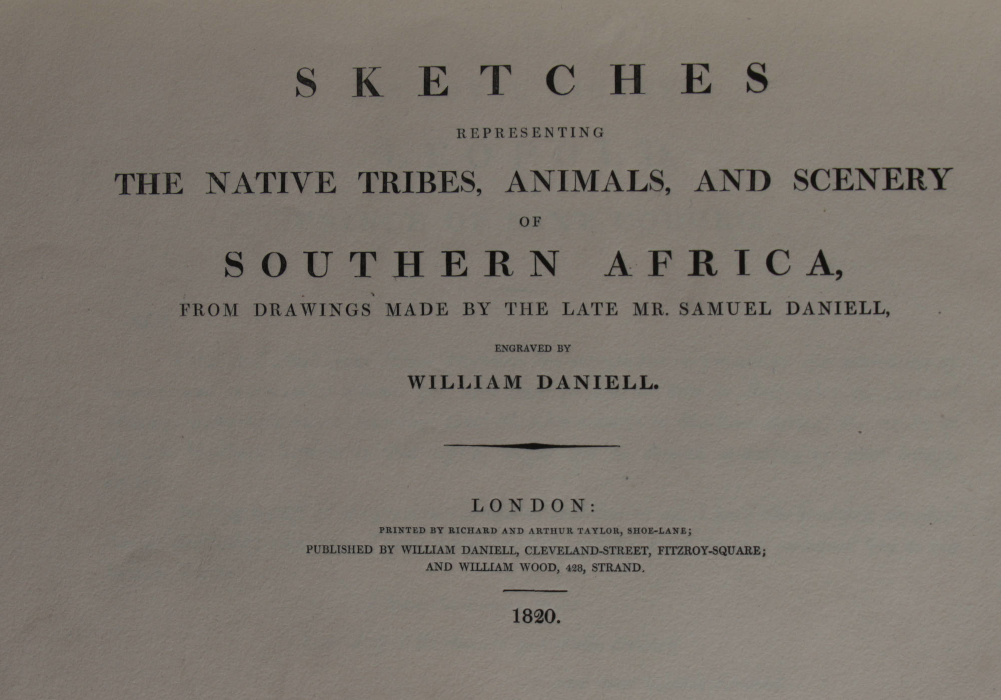
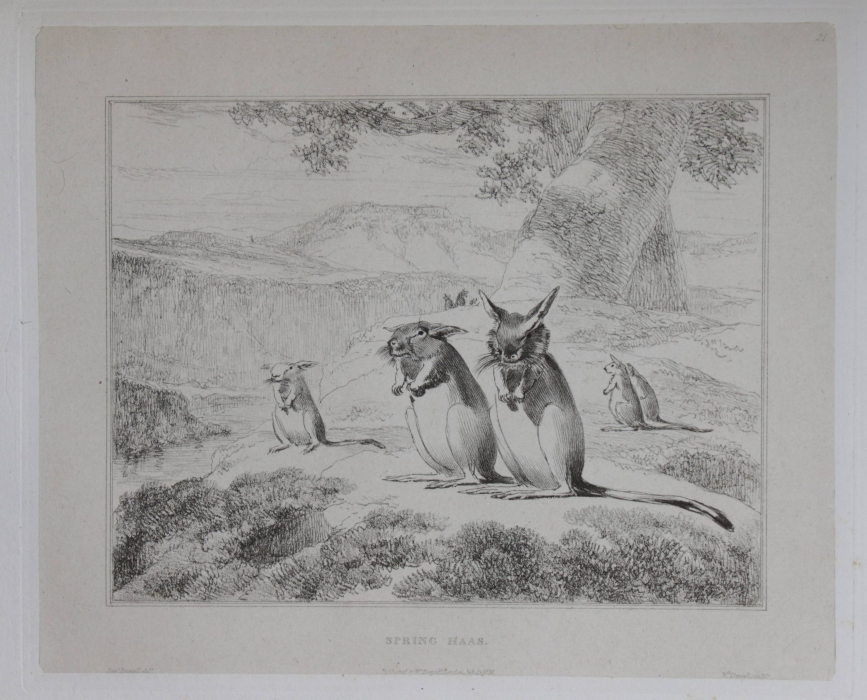
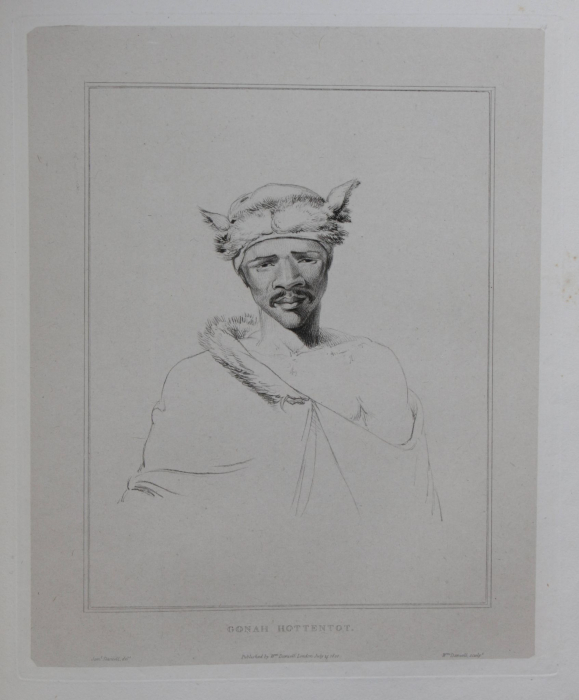
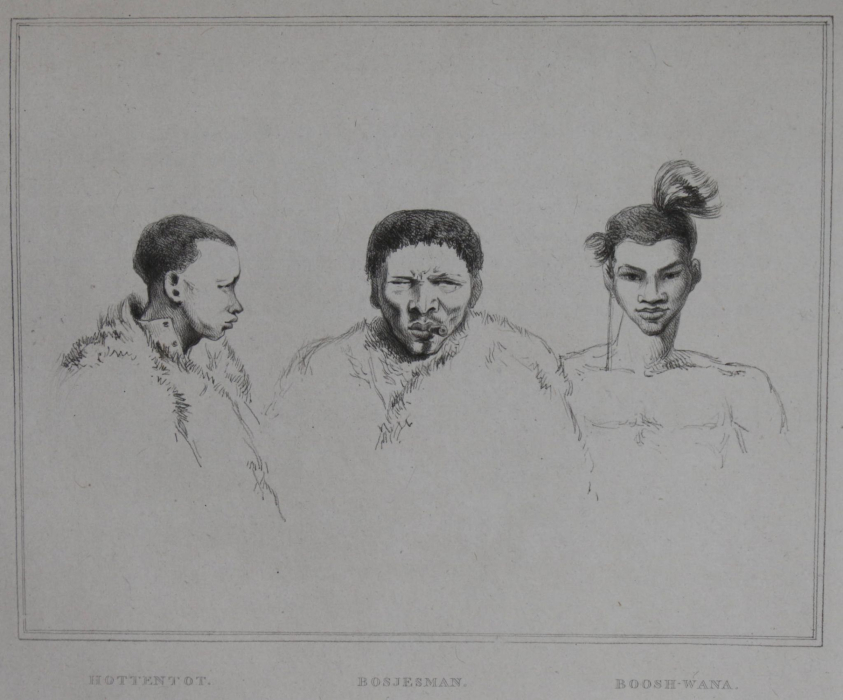
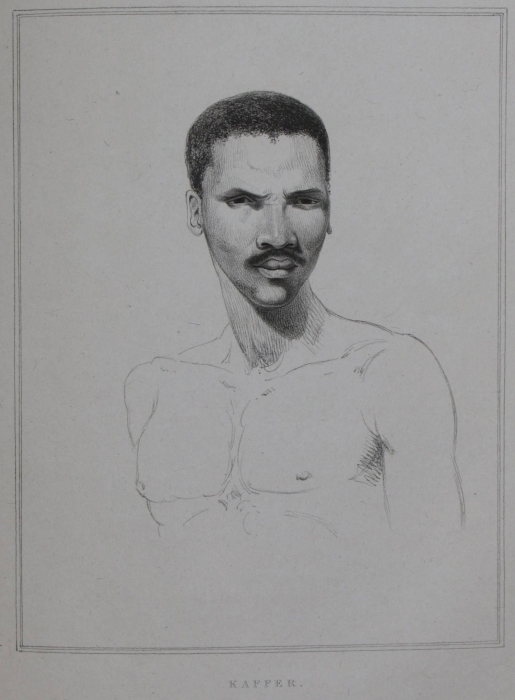
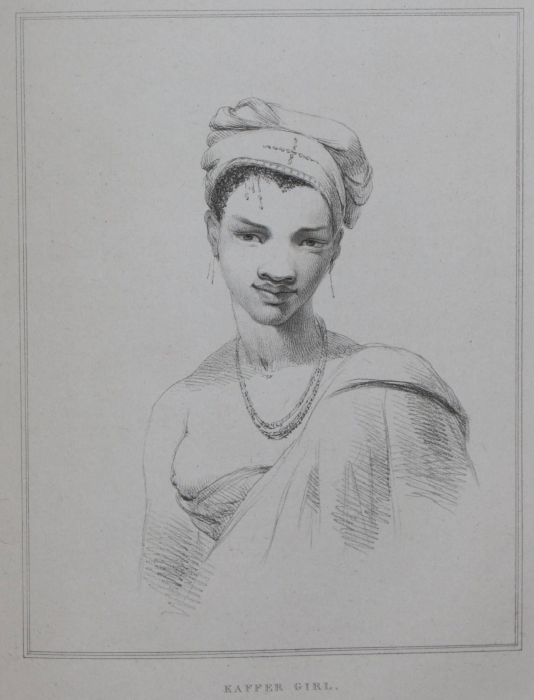
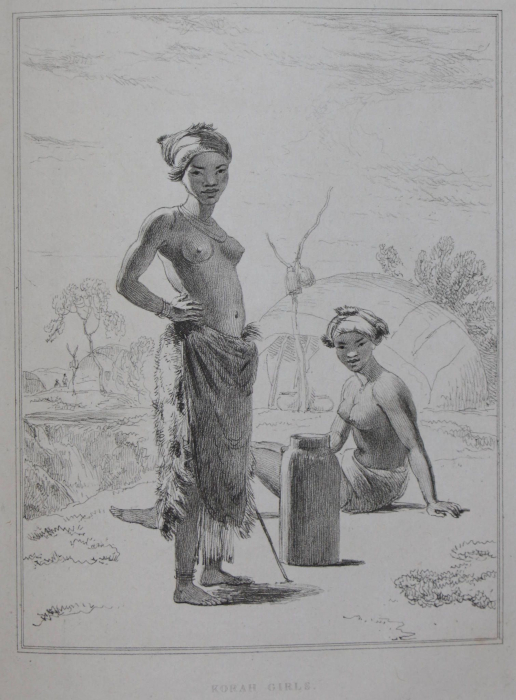
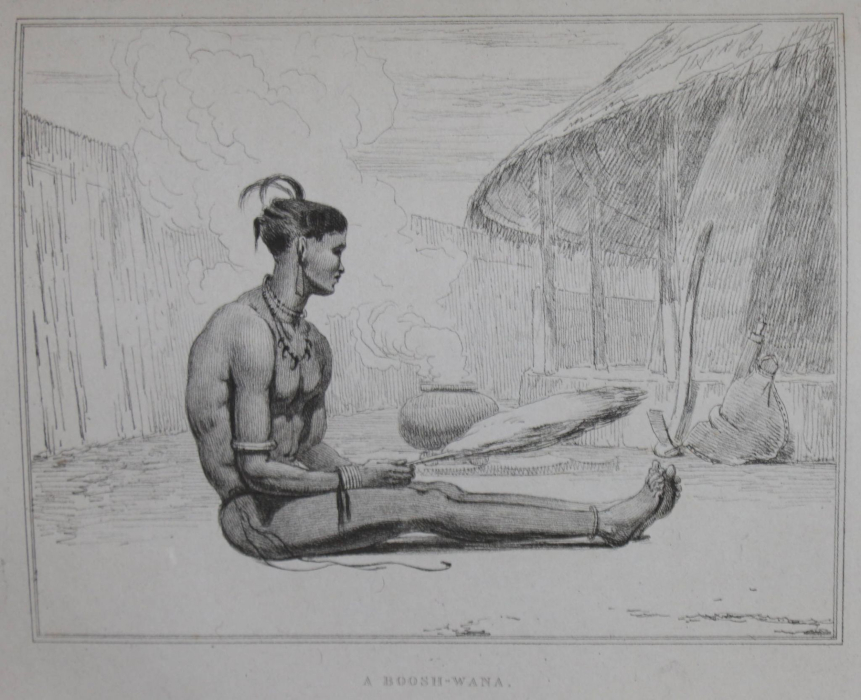
Sketches representing the Native Tribes, Animals, and Scenery of Southern Africa, from Drawings made by the late Mr. Samuel Daniell, engraved by William Daniell
Author: Daniell, Samuel
Year: 1820
Edition: First edition
Publisher: London; William Daniell and William Wood
A genuine, extremely rare large paper copy of an otherwise scarce, beautifully illustrated book.
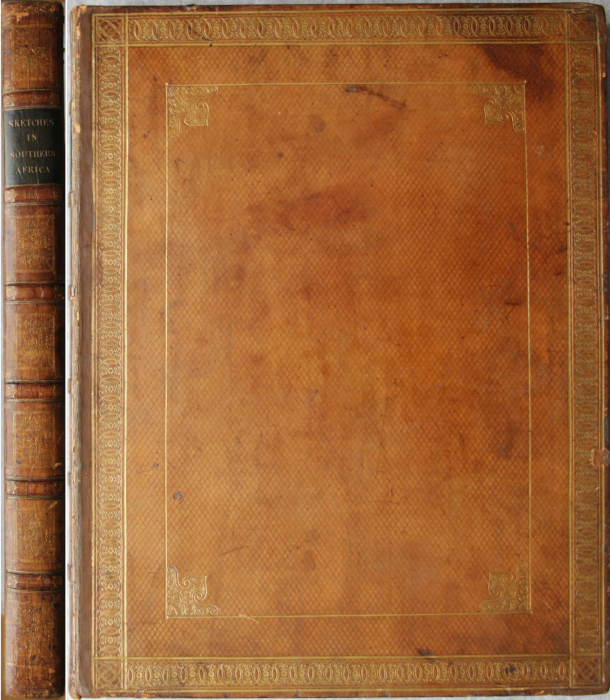
A magnificent contemporary full diced calf binding with the boards panelled in gilt; gilt corner pieces within a single gilt filet, surrounded along the edges by gilt stamped floral rolls within double gilt filets with four corner pieces. Gilt dentelles and inner-dentelles. Oblong folio, bound upright. Expertly rebacked with the original spine laid down and retaining original endpapers. The spine divided in seven compartments by six gilt decorated raised bands with double gilt filets at either side and with the title on a black morocco label in the second compartment. The other compartments gilt tooled within triple gilt filets with corner pieces. All edges marbled.
Some leaves watermarked ” J. Whatman / Turkey Mills / 1819 “.
Grey pastedowns and flyleaves with the bookplate of G.R. Nicolaus {¹} on the front pastedown.
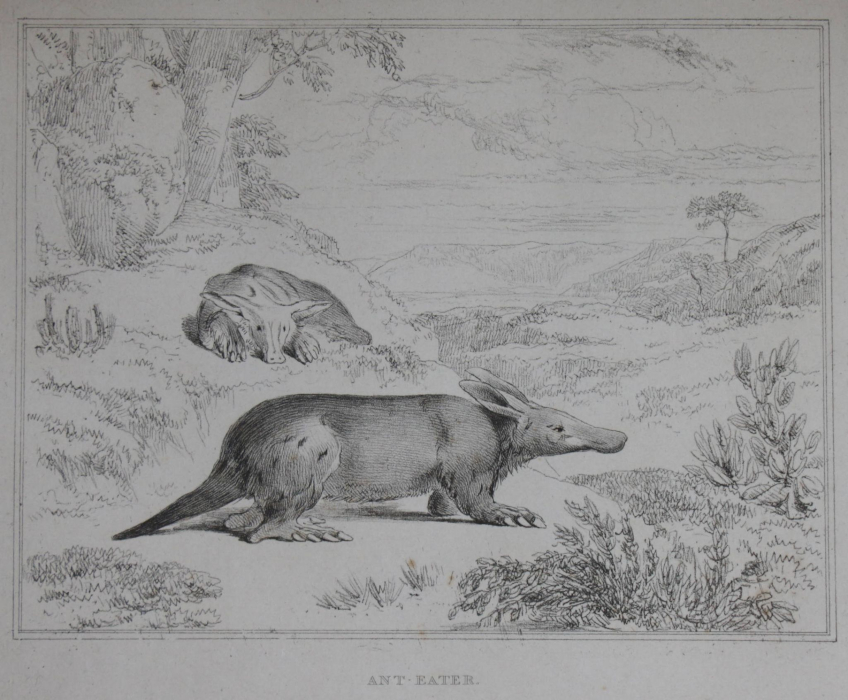
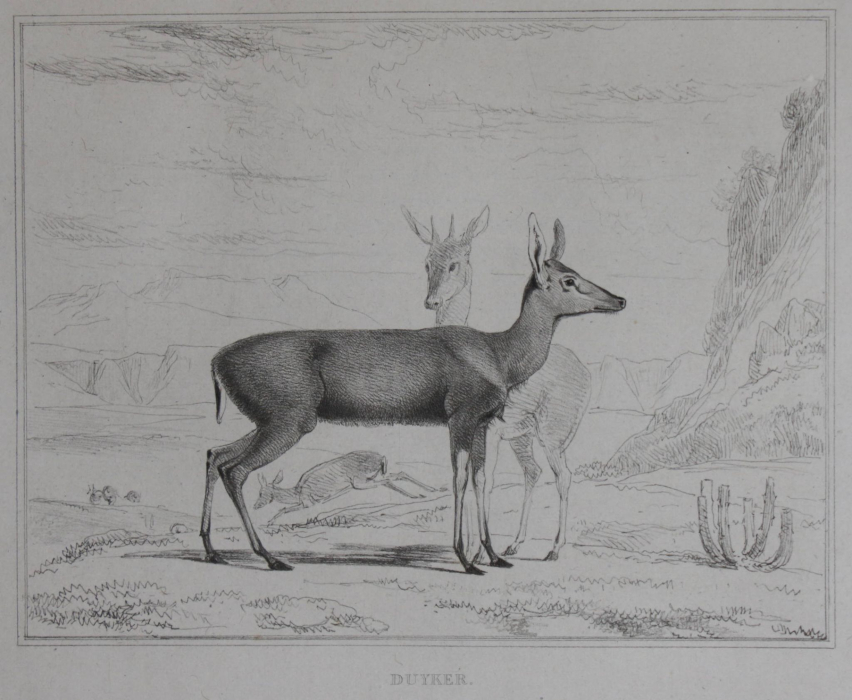
Collation: 2 preliminary blanks, half title, title, dedication page, editor’s foreword, contents leaf, followed by 48 plates printed on India paper and mounted on heavy paper, each print followed by a leaf with descriptive letterpress, 2 trailing blanks.
There are 48 text leaves, numbered 1 – 48 on the recto sides while the verso sides are blank. The plates are numbered 1 – 48 in the top right corner (there exist copies with the plates unnumbered) and signed Sam’l Daniell, del’t on the bottom left side and W’m Daniell sculp’t at the bottom right side. Plate nr. 23 misnumbered 32, corrected in pencil by a previous owner.
The plates are soft-grounded etchings and have all been engraved by Samuels brother William, while the accompanying text was written either by Mr. John Barrow or Dr. William Somerville.
Minor soiling to the boards, light rubbing to extremities, light foxing to the mounts of a few plates, the corners of just a very few mounts creased, but overall a clean and attractive copy of a very special book.
An extremely rare and exceptional copy, both in size and in completeness.
Abbey lists various oblong and upright sizes in inches, viz.:
10 ¼ x 14 ¼ Abbey’s copy
11 x 15 Mendelssohn I
13 ⅝ x 11 British Museum
13 x 10 Mendelssohn II
12 ¾ x 16 ½ Victoria and Albert Museum (VAM)
He concludes that only the VAM copy is a large paper copy. In the VAM copy the plates are printed on India paper, as in a few other copies, while, as auction records prove, most copies were printed on plain paper, the cheapest variant (£ 3. 3s) published, according to Abbey. The prices of the other issues were respectively £ 4. 4s for the copies with the plates printed on India paper and £ 8. 8s for the large paper issue with the plates on India paper as well. Opinions vary whether only 25 copies in total were printed with the plates on India paper, including the large paper issue, or that 25 copies each were printed on India paper, both of the smaller paper size and the large paper copies.
Neither in ABPC nor in RBH there is a record of a large paper copy.
The paper size of this copy is 405 x 310 mm (binding 415 x 325 mm), so it matches the size of the VAM copy, however, unlike the VAM copy it is bound upright. Including this copy only five large paper copies are known, all with the plates printed on India paper and all printed in the oblong format. {2}
Samuel died in Ceylon in 1811. His brother obtained the drawings and decided to have them published.
Mendelssohn I, pp. 412/413: … Mr. Samuel Daniell accompanied Dr. Sommerville and Mr. (afterwards Sir John) Barrow on an expedition into the interior of South Africa, and the collection of sketches included in this volume are the result of his researches while pursuing those studies in natural history to which he devoted his life. ” He was indefatigable in the pursuit of the various subjects he has delineated ; and it was his constant care to see the animals alive, that he might make himself master of their actions and habits. To the knowledge acquired in this way he added all that could be obtained in the country which produced the animals he has represented by conversations with the peasants and the natives.” …
However true the description by Mendelssohn may be, it should be emphasized how sensitive the portraits of the people of South Africa are as drawn by him. They are proud, strong and beautiful as is clearly shown in the magnificent portraits in this book. The captions (Bosjesman, Kaffer, etc.) clearly are due to the ignorance of a past era and the Daniell brothers are not to be blamed.
Abbey: Of his choice of soft-ground etching for the reproduction of his brother’s drawings William says he has merely to add with respect to the Engravings, that he has endeavoured to transfuse into them the spirit of the originals by a process which appeared to him best calculated for the attainment of that object. It is a most beautiful and sensitive work. One can well believe that William has not intruded himself but has indeed kept the spirit of the originals.
This book appeared in two formats; oblong folio and quarto. Mendelssohn first gives a comprehensive description of the quarto edition, followed by a concise description of the oblong folio format. Therefore, some consider the oblong folio edition to be a second issue. However, these are just assumptions as Mendelssohn makes no remarks about the issue. Abbey, who apparently conducted some extensive research, notes:
There seems to be no evidence as to the order of priority.
In addition it is of some importance to be aware of that all known large paper copies are the copies published in the oblong folio format.
Biblio: Abbey Travel 326, Gay 3136, Hosken p. 55, Mendelssohn I, pp. 412, 413.
A superior copy of this rare book in an exquisite binding.
{¹} G.R. Nicolaus was a partner in the London based firm of Mercer, Nicolaus, and Co., a firm specialized in worldwide geological surveys for metals, fossil fuels and the like. He also was a great bibliophile.
{2} During the first half of 2021 I contacted all libraries that are listed in WordlCat having a copy of this book and those dealers who had a copy in stock. Also auction records (RBH, ABPC) were checked. This to find out the number of large paper copies in existence in institutional libraries and elsewhere, as well to see how many copies have their plates printed on India paper.
The paper sizes differ greatly from 338 x 255 mm (Royal Academy of Arts) to 335 x 430 (one of the two copies in the library of the Smithsonian Institution).
Most copies were in the range from 350/370 x 280/290 mm (upright) or 250/270 x 360/380 mm (oblong).
So defining what exactly is a large paper copy might be arbitrary but five copies have a paper size well over 400 mm, all five copies were printed in oblong format and they all have their plates printed on India paper. These copies are in the following libraries:
Columbia University – Rare Book and Manuscript Library
Library of the Victoria and Albert Museum
State Library of New South Wales (bound upright, like this copy)
Library of the Smithsonian Institution
Iskandar Books (the copy described here)
Neither did I find large paper copies in auction records, nor with rare book dealers.
All large paper copies are complete with half title and dedication page. In all other copies either the half title, the dedication page or both are missing, though I am not sure about the copy auctioned by Christies in their London sale of 30 April 2008, as they do not remark anything about both pages.
Apart from the five large paper copies with the plates printed on India paper I found nine other copies with the plates printed on India paper, of which the smallest measured 344 x 280 mm and the largest was 369 x 300 mm. All non-large paper copies are printed (and bound) upright.
These copies are in the following libraries, or were offered by auction houses and dealers:
Yale University – Beinecke Library
Library of Congress
Library of the University of Pretoria
Library at the Royal Academy of Arts
The second Hosken copy
Three copies auctioned by Christies in 1968, 2004 and 2008 respectively
Shapero Rare Books (Travel catalogue 2021, item #16)
In all other copies in institutional libraries, offered on auction or by dealers, the plates are printed on plain paper.
Taking into consideration that (especially) the copies printed on India paper were valuable books at the time of printing and always have remained valuable, it seems not unreasonable to assume that the 25 copies mentioned by Sutton and the 25 copies mentioned by Bohn in fact is the total number of copies, either Imperial 4to or smaller, with the plates printed on India paper, as I have been unable to trace a large paper copy with the plates printed on plain paper, which seems to be logical.
Privately acquired in South Africa in 2019.